Skip to content
Custom Packly

Custom Packaging FAQs

Clear answers on custom boxes, artwork, materials, print finishes, delivery, samples and quote requests before starting your packaging project.

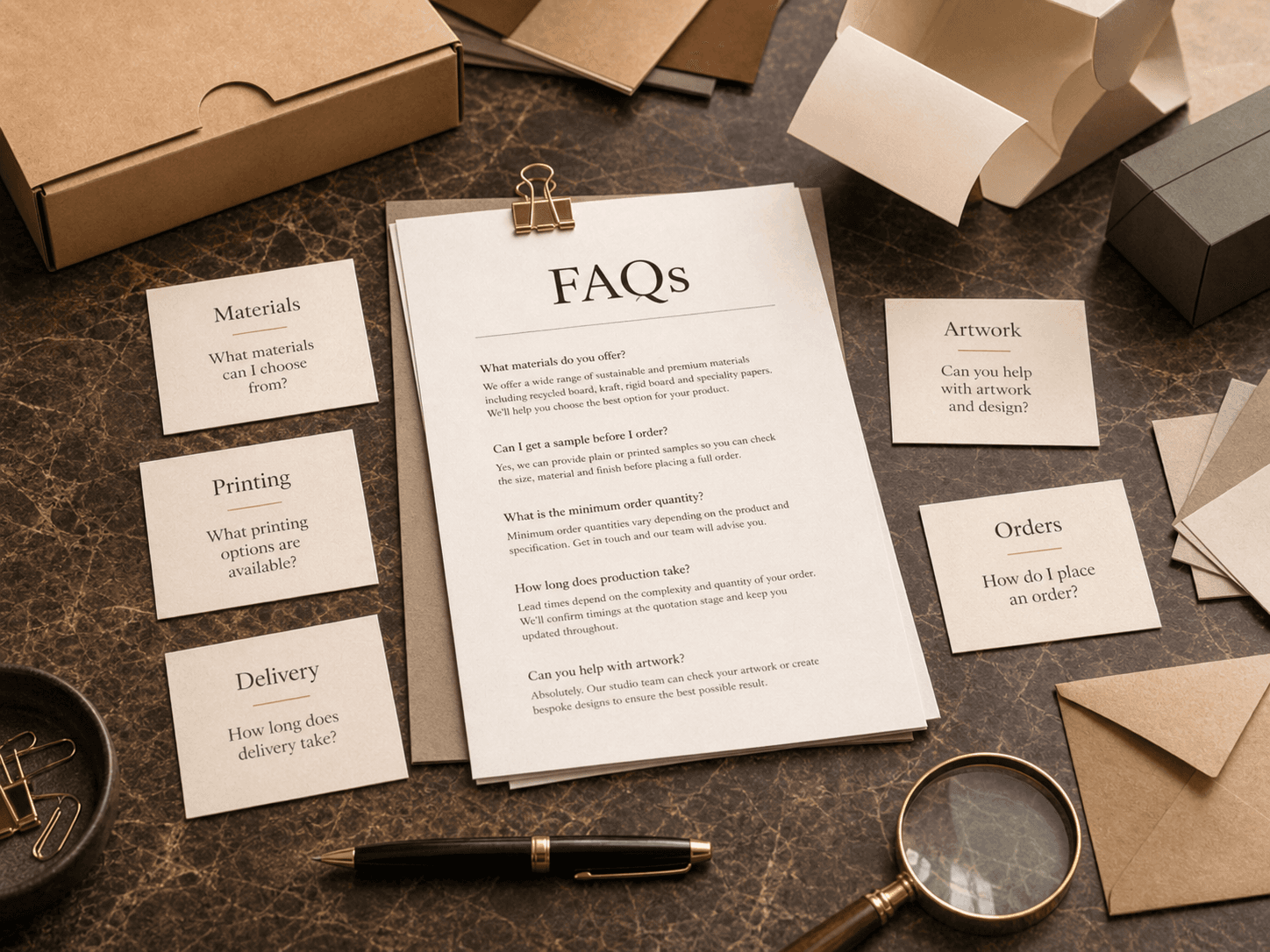
Warm editorial FAQ hero image showing a help guide document, question cards, packaging samples, a pen and paper-based materials on a refined tabletop.

Answers Before You Request a Quote

Custom packaging questions are easier to answer when the product, size, quantity, material and finish are clear. This page covers the most common points people ask before ordering printed boxes, mailers, rigid packaging, sleeves, tubes, paper bags, inserts and other paper-based packaging. Use these answers to prepare your details, avoid artwork delays and understand what affects pricing, production and delivery.

Orders and Quotes

Send your product details through the quote form with the packaging style, size, quantity, artwork status and delivery location if known. If you are unsure about the right box type, share the product use and we can guide the quote around suitable packaging options.

The most useful details are product dimensions, order quantity, preferred packaging style, material choice, printing needs, finish preferences and delivery deadline. Photos or existing packaging references also help. More complete details make the quote clearer and reduce back-and-forth before production.

Yes, you can start with rough dimensions. Share the product size, weight and how it will be packed. Exact measurements are usually confirmed before artwork and production begin so the final packaging fits correctly.

Low MOQ options may be available depending on the packaging type, material, print method and finish. Smaller runs are often useful for launches, test batches, seasonal products and early-stage brands. The best option depends on the structure and print requirements.

Yes. You can include multiple products in one enquiry. List each product separately with its size, quantity and preferred packaging type. This helps compare shared materials, matching print finishes and possible size variations across the same project.

Pricing changes with quantity, board type, size, structure, print coverage, finishes, inserts and production complexity. A simple printed carton and a rigid presentation box will not be priced the same because they use different materials, construction methods and finishing steps.

Custom Sizes and Packaging Styles

Yes, custom-sized packaging can be made around the product dimensions. The product’s length, width, height, weight and extra space for inserts or tissue should be confirmed before production. A good fit improves presentation and reduces movement during handling.

Choose the style based on product weight, sales channel, presentation needs and delivery method. Rigid Boxes suit premium presentation, Mailer Boxes suit ecommerce delivery, Sleeve Packaging adds branding to trays or cartons and Inserts and Dividers help hold products in place.

Sometimes. A shared outer box can work when products are close in size or when inserts are used to control fit. If the size difference is large, separate box dimensions usually give a cleaner presentation and better protection.

Yes, paperboard and cardboard-based inserts can be used to hold products, separate items or improve the reveal inside the box. Inserts are especially useful for cosmetics, jewellery, candles, electronics, gift sets and fragile ecommerce products.

Mailer Boxes are better for branded ecommerce presentation and lighter direct-to-customer orders. Shipping Boxes are usually better for heavier goods, bulk dispatch or stronger transit needs. The right choice depends on product weight, protection needs and the desired unboxing experience.

Yes, but the structure must support both display and delivery. A retail carton may need extra protection when shipped, while an ecommerce mailer may need stronger branding for unboxing. The best approach is to confirm where the product will be seen, stored and delivered.

Artwork and Dielines

Not always. If you already have a dieline, you can share it for review. If not, the correct dieline can usually be prepared once the packaging style, size and structure are confirmed. Artwork should be placed on the approved dieline before print.

Vector files are best for logos and sharp print details. AI, PDF or EPS files are usually preferred where available. High-resolution images should be supplied clearly and any fonts should be outlined or included to avoid missing text issues.

Yes, you can begin with a logo. A logo is enough for a simple branded layout, but full artwork is needed for complete printed packaging. Share brand colours, text, product details and any design direction if you want a more developed print layout.

Bleed is extra artwork that extends beyond the final cut edge. It prevents unwanted white edges if the printed sheet shifts slightly during cutting. Packaging artwork should include bleed wherever colour, pattern or imagery reaches the edge of a panel.

Yes, many box styles can be printed inside and outside. Inside print works well for brand messages, care instructions, launch notes or premium unboxing detail. It may affect pricing and production so it should be included in the quote request.

Yes, artwork proofing is normally part of the approval process before production. A proof helps check layout, text, panel placement and print direction. It should be reviewed carefully because production follows the approved artwork.

Materials, Print and Finishes

Common choices include paperboard, kraft board, corrugated board, rigid board and other card stocks depending on the packaging type. The right material depends on product weight, finish choice, display needs, delivery method and the level of presentation required.

Many paper and cardboard-based packaging options can be recyclable, especially when kept simple and free from unnecessary mixed materials. Recyclability can be affected by coatings, lamination, foils, windows and special finishes so material choices should be confirmed early.

Matte lamination gives a softer, more understated surface with less shine. Gloss lamination creates a brighter reflective finish that can make colours look more vivid. Matte often suits premium or minimal branding while gloss works well for bold retail graphics.

Foil stamping works well when you want a metallic detail, logo highlight or premium accent. It is often used on rigid boxes, gift packaging, cosmetic boxes, jewellery boxes and luxury retail packaging. It should be used selectively so the finish feels intentional.

Spot UV is useful when you want selected areas to catch the light, such as a logo, pattern or product name. It works best as a contrast against matte surfaces. The artwork needs accurate setup so the raised or glossy area aligns correctly.

Kraft can be printed, but colours look different on brown board compared with white stock. Darker colours, black artwork and simple branding usually perform well. If bright colour accuracy matters, white paperboard may be the better material choice.

Samples and Approvals

Samples may be available depending on the packaging style and project stage. A sample can help check size, structure, material feel and opening style before committing to a larger order. Printed samples usually take longer and may cost more than plain samples.

A plain sample helps confirm structure, dimensions, board feel, folding, closure and product fit. It does not show final print colour or finishing quality. Plain samples are useful when the main concern is whether the packaging holds the product correctly.

No, a printed sample is not always necessary. It is more useful for premium launches, complex artwork, colour-sensitive branding or special finishes. For simpler projects, artwork proofing and a plain structural sample may be enough before production.

A sample can give a useful colour direction, but exact colour can still vary with material, coating, print method and production conditions. For colour-critical work, Pantone matching or a controlled proofing process should be discussed before approval.

Check dimensions, spelling, logo placement, barcode position, colour direction, panel orientation, finish areas and dieline alignment. Also confirm quantity, delivery address and packaging style. Once approved, changes may not be possible without affecting cost or timing.

Delivery and Turnaround

Turnaround depends on the packaging type, quantity, material, print method, finishes and artwork readiness. A simple printed carton may move faster than a rigid box with inserts and foil. Timelines should be confirmed during quoting because each project has different production needs.

Production timing usually starts after the quote, specifications, artwork and payment terms are approved. Delays often happen when artwork files are incomplete, dimensions change or finishes need extra confirmation. Fast approval helps keep the project moving.

Yes, delivery can be arranged across the UK. Delivery time depends on order size, destination, packaging type and courier or freight requirements. Larger orders or bulky corrugated packaging may need different handling than smaller parcel deliveries.

Urgent requests can be reviewed, but availability depends on the structure, quantity, material and artwork readiness. Share the deadline as early as possible. The simplest way to improve speed is to provide complete specifications and print-ready artwork from the start.

Common delays include missing artwork files, unclear dimensions, late design changes, unapproved proofs, complex finishes, material availability and incomplete delivery details. Any change after approval can affect production so key details should be checked carefully before sign-off.

Changes, Reprints and Order Issues

Changes may be possible before production starts. Once artwork has moved into production, changes can be difficult or may require extra cost. Always review proofs closely before approval, especially spelling, panel direction, barcode placement, colour notes and finish areas.

If the wrong size is approved before production, the final packaging may still be produced to that specification. This is why product dimensions, insert needs and internal space should be checked before sign-off. A sample can help reduce this risk.

Custom printed packaging is made to approved specifications so refunds are handled differently from standard stock items. Issues are reviewed based on the approved artwork, agreed dimensions, production details and the nature of the problem. Clear photos and order details help the review.

Contact the team quickly with order details, delivery photos and images of the damaged packaging. Keep the cartons and damaged items until the issue is reviewed. This helps confirm whether the problem happened in transit or during handling.

A reprint may be reviewed if the order does not match the approved specification or has a significant production issue. Artwork mistakes, incorrect supplied dimensions or approved spelling errors may not qualify. Each case needs evidence, order details and comparison with the approved proof.

What to Prepare Before Asking a Question

  • Product type and rough dimensions

  • Preferred packaging style if known

  • Quantity or estimated order size

  • Artwork status, logo files or dieline availability

  • Material, colour or finish preferences

  • Delivery location and deadline if relevant

  • Any existing packaging sample or reference photo

Helpful Support Pages

Use these pages if you want to compare options before sending a quote request.

  • Packaging Styles: Browse rigid boxes, mailer boxes, tubes, sleeves, paper bags, inserts, dividers, display packaging and shipping boxes by structure.
  • Industries: Find packaging ideas by product type, retail setting, ecommerce use, gifting need or delivery requirement.
  • Capabilities: Learn more about materials, printing, finishes, inserts, dielines and custom sizing options.
  • Contact: Ask a general packaging question before starting a quote request.
  • Request a Quote: Share your product details, quantity, artwork status and delivery needs for tailored pricing.

Still Have a Packaging Question?

If your question depends on product size, material, print finish or delivery timing, send the details through the contact or quote form. Clear product information helps the team recommend the right packaging style, confirm the next steps and avoid delays before production.