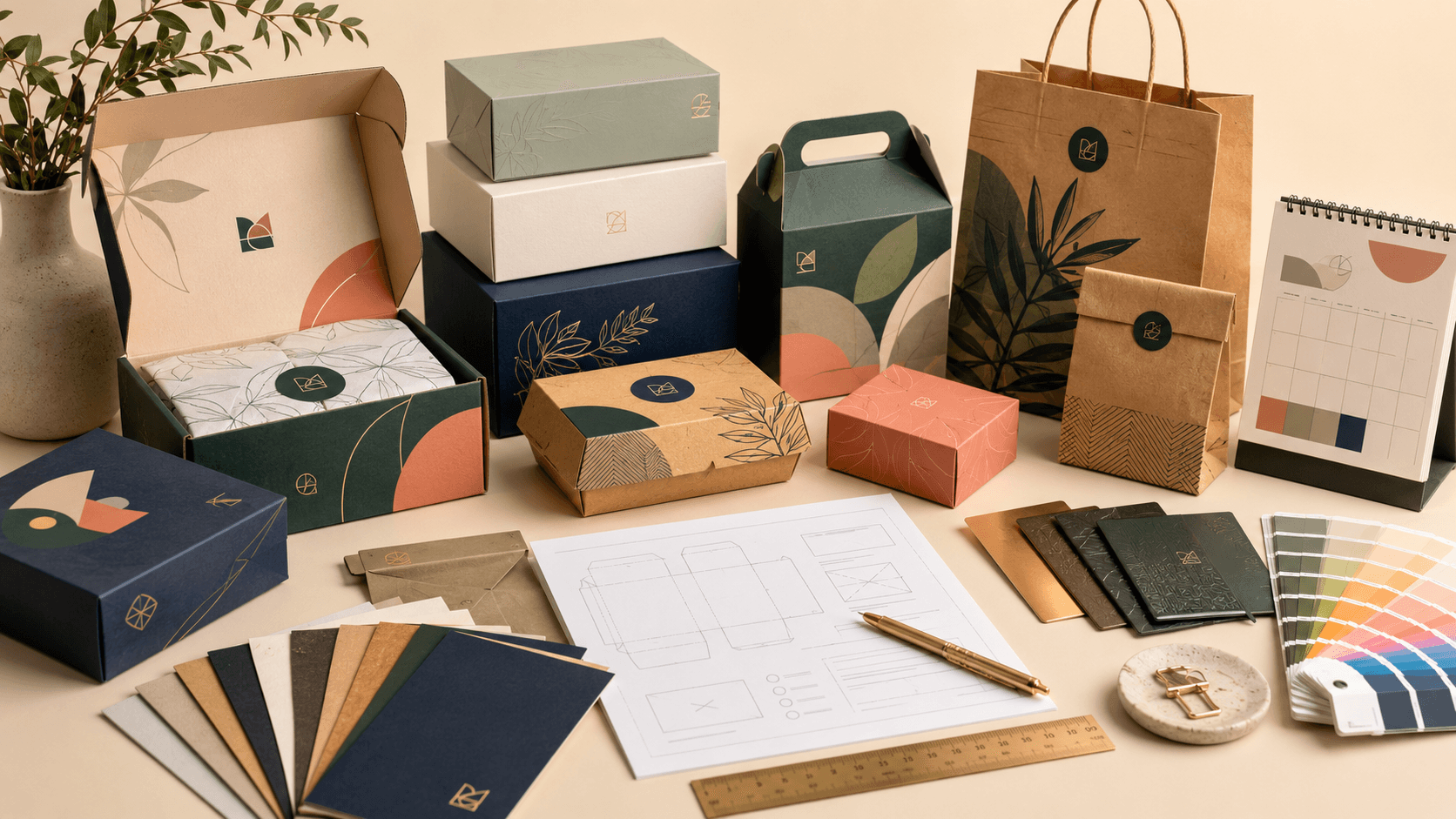
The minimum order quantity (MOQ) for custom printed boxes at Custom Packly starts from 100 boxes in the UK. That is the entry point, not a promise that every size, material, artwork variation or box construction can be manufactured in a 100-unit run. The exact minimum depends on how your packaging is specified and produced.
For a new product, 100 boxes can be a sensible way to begin. For an established product, a larger run may reduce the price per box but increase the amount of cash and storage tied up in packaging. The useful question is not simply how few boxes you can buy. It is which quantity gives you enough usable packaging at an acceptable overall cost.
What Does a 100-Box Minimum Actually Mean?
MOQ means the smallest production quantity accepted for a particular specification. In the UK, our advertised starting MOQ is 100 units. The applicable minimum should be checked against the finished box style, dimensions, board, printing, finishes and the number of distinct designs.
One artwork and several designs are different orders
Suppose you need 100 skincare cartons but want four fragrances, each with its own printed ingredients and colourway. Do not assume you can split the order into 25 of each design under a single 100-box minimum. Different artwork versions, sizes or cutting patterns can create separate setups. Ask whether the MOQ applies per design, per size, per structure or to a combined run.
For brands starting with one product or a small number of variants, custom packaging for small businesses is best planned around the actual first launch rather than an ambitious future product line. Agree the SKU breakdown before committing to a quantity.
Why Do Custom Printed Boxes Have an MOQ?
A custom box requires work that does not disappear when the run gets smaller. The supplier must establish the dimensions and construction, check the dieline and print artwork, prepare board, set up production and inspect the finished result. The cost and feasibility of that setup help determine the production minimum.
Printing has a setup cost
Offset lithography may require plates, press makeready, colour registration and calibration before production sheets are usable. Digital printing avoids conventional plates but still needs the correct substrate, files, finishing route and converting setup. A short-run digital quote is therefore not automatically the right answer for every box, nor is offset inherently the wrong method at lower quantities.
Board and box structure change the production route
A straightforward tuck-end carton and a rigid gift box with a wrapped lid and fitted insert require different materials and assembly processes. Die-cutting, gluing, laminating, foiling and special components can introduce additional setup or material minimums. Even boxes with similar external dimensions may have very different economical run sizes.
The central distinction is between fixed preparation and the variable cost of each additional box. This also explains why the total cost of custom packaging in the UK cannot be determined by quantity alone.

Which Box Styles Are Suitable for a 100-Unit Starting Order?
Many common box projects can be considered from 100 units, subject to the actual specification. Select a structure that performs the job before adding premium features that increase setup or make the run less economical.
Mailer boxes for first ecommerce runs
A printed corrugated mailer can combine parcel protection and branded unboxing for clothing, accessories, subscription products or sample kits. Check the board strength, internal fit and closing method as well as the print. Our mailer box structures cover the main options when the package must survive delivery.
Folding cartons for shelf-ready products
Tuck-end and other folding carton constructions suit many lightweight cosmetics, wellness products and retail items. Standardised closure styles may be more practical for a first run than a complicated custom opening. Compare the different box styles and shapes around how the product is packed, displayed and opened.
Rigid boxes for a premium product
A relatively straightforward lid-and-base rigid box may be feasible at a lower quantity, whereas magnetic closures, elaborate wrapping, custom inserts and selective finishes can change the minimum and unit cost. If presentation is the priority, compare rigid box constructions before assuming that every premium box needs the same production run.
Food and bakery boxes
Printed food and bakery cartons may also begin from the UK starting quantity, depending on the design. The decisive details include product weight, grease or moisture exposure, closure, handling temperature and whether the board or lining is suitable for the intended food contact. Do not assume a printed carton is food-contact approved without confirming the exact material and use.

When Can the Minimum Rise Above 100 Boxes?
The 100-box starting point does not make every speciality construction a 100-box product. Minimums can be higher when the manufacturer has to source unusual materials, make dedicated components or use more involved production and finishing stages.
For example, cardboard and paper tube packaging can involve winding, end caps, lids and specialist wrapping processes rather than cutting and folding a flat carton. Some printed paper bag structures require specific handle material, bag-making equipment or more specialised finishing. Certain luxury rigid packs, unusual shapes and custom insert combinations can also move beyond a standard short run.
The correct action is to submit the exact intended design and ask for its minimum. Avoid promising a customer 100 units of a highly specific format merely because the supplier advertises MOQ from 100. If a higher minimum is quoted, request an alternative specification as well as the original price.
How Quantity Changes Unit Cost: 100 vs 250 vs 500 vs 1,000
Increasing the quantity of the same box specification will often reduce its unit cost because setup is distributed across more finished boxes and production can become more efficient. But a lower price per box does not automatically make a larger order cheaper for the business.
For a useful comparison, ask for prices at 100, 250, 500 and 1,000 boxes where those quantities are manufacturable. Compare each tier using identical dimensions, material, printed sides, artwork count, finish, insert and delivery assumptions. Otherwise, a cheaper quote may simply describe a less expensive box.
Think in terms of cash committed and boxes used
These are decision examples, not universal price bands or separate guaranteed MOQs. The economics depend on the actual quote. If 500 boxes have a lower unit price but your product or artwork changes after the first 100 are used, the remaining stock may erase the apparent saving.
A simple purchasing test is: total spend on the order ÷ number of boxes you realistically expect to use. Add storage, disposal, relabelling and reordering costs where they matter. That is a more honest measure than choosing the lowest displayed pence-per-box figure.

Is Ordering 100 Boxes Enough for a Product Launch?
It can be. A 100-box first run is often appropriate for one product with a defined launch plan, a working box specification and uncertainty about initial sales. It gives a brand a manufactured pack to use for photography, retail introductions and genuine orders without taking on thousands of units before there is proof of demand.
Consider an illustrative skincare launch with one bottle size and one printed carton design. A 100-box run lets the team assess pack-out speed, shelf appearance, product clearance and customer response. If the bottle or label changes after launch, less old packaging is left unused. This is an example of a sensible trial approach, not a claimed Custom Packly customer result.
The opposite situation is a business with several stable high-selling SKUs, regular monthly dispatches and adequate storage. For that buyer, repeated minimum-size orders may waste time and increase cost. A planned bulk custom box order may be the better fit if specifications and demand are stable.

Can You Order Fewer Than 100 Custom Printed Boxes?
Custom Packly's stated UK starting MOQ is 100 boxes, so you should not plan a fully custom printed production order below that threshold. A one-off prototype, a pre-production sample and a small batch of retail-ready printed cartons are different purchases and should not be treated as interchangeable.
If you need only 10 or 20 packages for a concept test, an off-the-shelf box with a separately printed label or sleeve may be an alternative to investigate. It will not offer the same fit or print integration as a production custom box, but it can avoid ordering more finished packaging than the test needs. Confirm availability and the economics separately rather than assuming a sub-100 production exception.
Does the Printing Method or Number of SKUs Change MOQ?
Yes, it can. The production plan changes when a single 500-box artwork run becomes five different 100-box designs. Each unique design may need file checks, colour control or separate setup; changing dimensions can also require a different dieline or cutting forme. That is why the total units across all SKUs do not always qualify as one production quantity.
Digital and offset printing have different setup and repeat-run economics. Digital may suit some short or variable-data applications; offset is frequently attractive when a stable design is repeated in larger quantities. Neither method guarantees that all materials, box formats and finishes can be produced at the same MOQ. The detailed digital versus offset packaging printing analysis helps separate the printing decision from the box-quantity decision.
When requesting a quote, give the count for each size and artwork version, not just the grand total. If cost is high, ask whether common dimensions, a shared base design or a simpler finishing specification would make the run more practical.
Check Product Fit and Proofing Before Increasing Quantity
A low MOQ helps limit initial exposure, but it does not solve an incorrect box size. Measure the product as it will actually be packed, including lids, pumps, handles, protective wrap and any inserts. Allow for board thickness and the correct internal clearance. A visually attractive box that damages the product or slows packing is still the wrong specification.
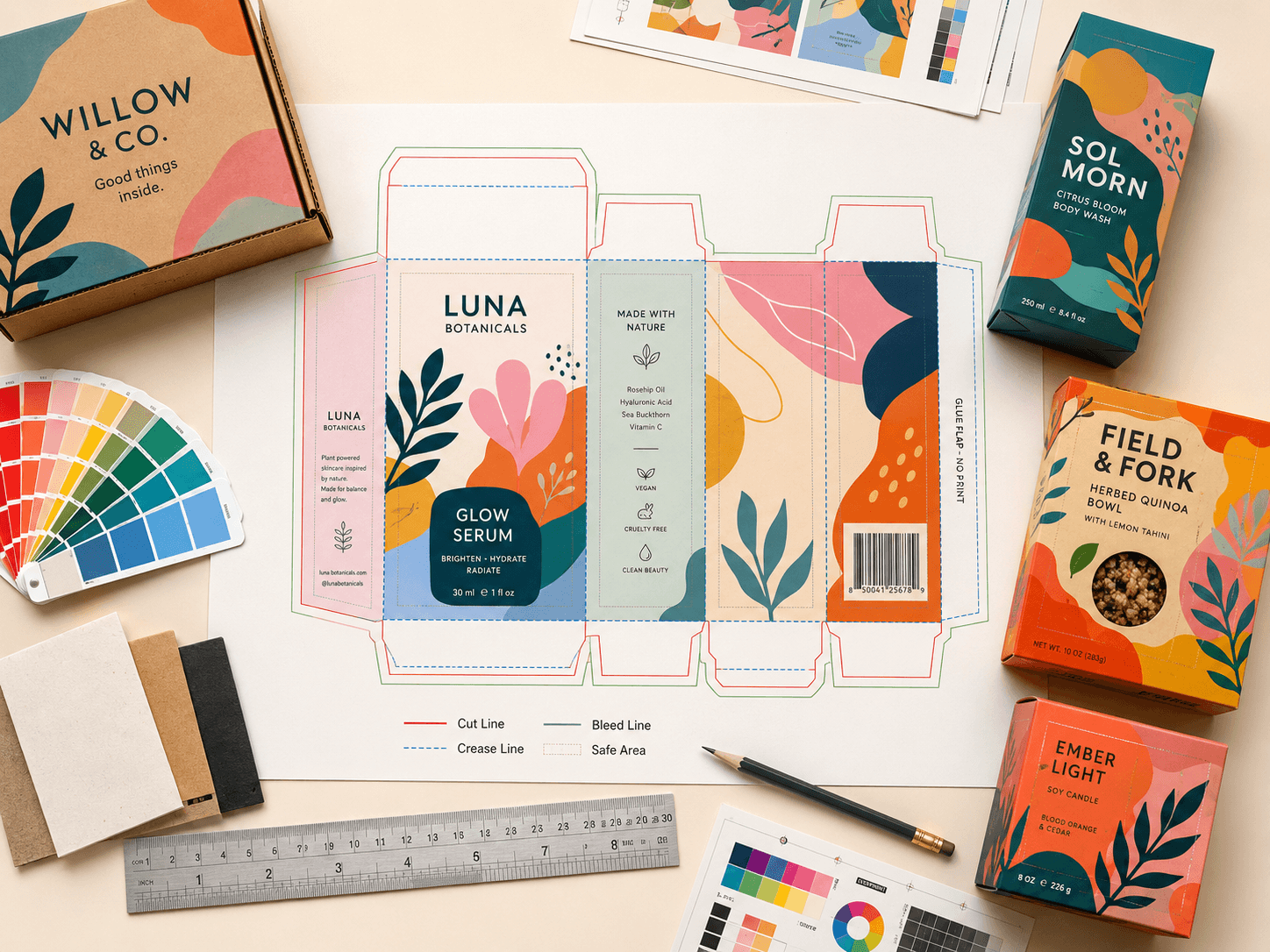
A dieline governs where the artwork, cuts, folds and glue areas sit. Free design and dieline support and free 3D mockups can help you resolve the layout and visual direction before approving production. If you are preparing artwork yourself, use the packaging dieline and artwork setup explanation to check the important production boundaries.
What a 3D mockup cannot prove
A 3D visual does not demonstrate exact physical fit, the feel of a paper stock, the resistance of a closure or the performance of an insert in transit. Free examples of previous packaging work may be available for inspection. A fully custom physical pre-production sample is a paid option and is most useful when a fit, finish or opening characteristic needs physical validation.
UK turnaround is currently stated as 4–6 working days, normally counted after final specifications and artwork approval; confirm the schedule for the exact box because special materials and complex finishes may need additional time. Do not build your launch plan around the quickest possible date before the specification has been approved.
Choose the Order Size Around Your Real Sales Pattern
The best quantity is the smallest economical run that covers your expected use without creating an unreasonable stock or cash risk. Start from the demand you can support, then assess the packaging design's likelihood of changing before the boxes are used.
Four questions worth answering before you buy
For an established range, warehousing and scheduled deliveries may help when a larger run improves unit economics but you do not want the complete order on your premises. That is a separate supply-planning conversation, not a reason to buy more than the business can realistically use.
Avoid the common trap of optimising only for unit price. Poor size selection, unnecessary finishes and unused stock are among the costly packaging purchasing mistakes that can outweigh a nominal bulk saving.
What to Send for an Accurate MOQ and Quantity Quote
A useful request identifies not only how many boxes you want but what production run those units actually represent. You can start with estimates if the final specification is still being developed.
These details separate minimum production feasibility from the total commercial decision. If you are unsure what belongs in an enquiry, preparing an instant packaging quote outlines the information that moves pricing forward.

For the specific box you want, request a custom printed box quote and ask for the minimum manufacturable quantity alongside comparable prices for your preferred tiers. Custom Packly provides instant pricing, UK production, free delivery and support with artwork and 3D mockups where applicable; the final offer should reflect your actual specification.
Frequently Asked Questions About Custom Box MOQs
Is the UK minimum order 100 boxes per design?
The UK starting MOQ is 100 boxes, but the minimum for each artwork version, size or construction must be confirmed. Do not assume 100 units can be divided freely between multiple designs.
Does an MOQ of 100 mean every box type starts at 100?
No. It is the starting point for qualifying projects. Specialist tubes, bags, elaborate rigid boxes, uncommon substrates and certain finishing processes may require a higher run.
Are 500 boxes always cheaper than 100?
The price per box often falls as quantity rises for an otherwise identical specification. The total order costs more and surplus packaging can make the larger run a worse investment. Compare usable quantities and overall spend.
Are custom physical samples free?
Free examples of previous work and free 3D mockups may be available. Fully customised physical pre-production samples are paid, so discuss their purpose and cost before requesting one.
Can I change the artwork after approving the order?
Changes before final approval may be possible but can affect price and timing. Once production has started, artwork or structural changes can require new setup or a new run. Confirm the approval stage with the packaging team.