Choosing between different types of boxes for packaging should start with one question: what does the box physically need to do?
In my experience, businesses often start in the wrong place. They think about colour, foil, unboxing or whether a rigid box looks more premium. Those decisions matter, but they come later.
I use a much simpler hierarchy:
Structure first. Logistics second. Brand presentation third.
A lightweight retail carton, a corrugated ecommerce mailer and a rigid presentation box may all look excellent when photographed, but they solve completely different packaging problems.
At Custom Packly, the strongest packaging decisions usually begin with the product itself: dimensions, packed weight, fragility, sales channel, delivery environment, storage constraints and packing process. Once those are understood, choosing the material, structure, print and finishes becomes far easier.
Quick Answer
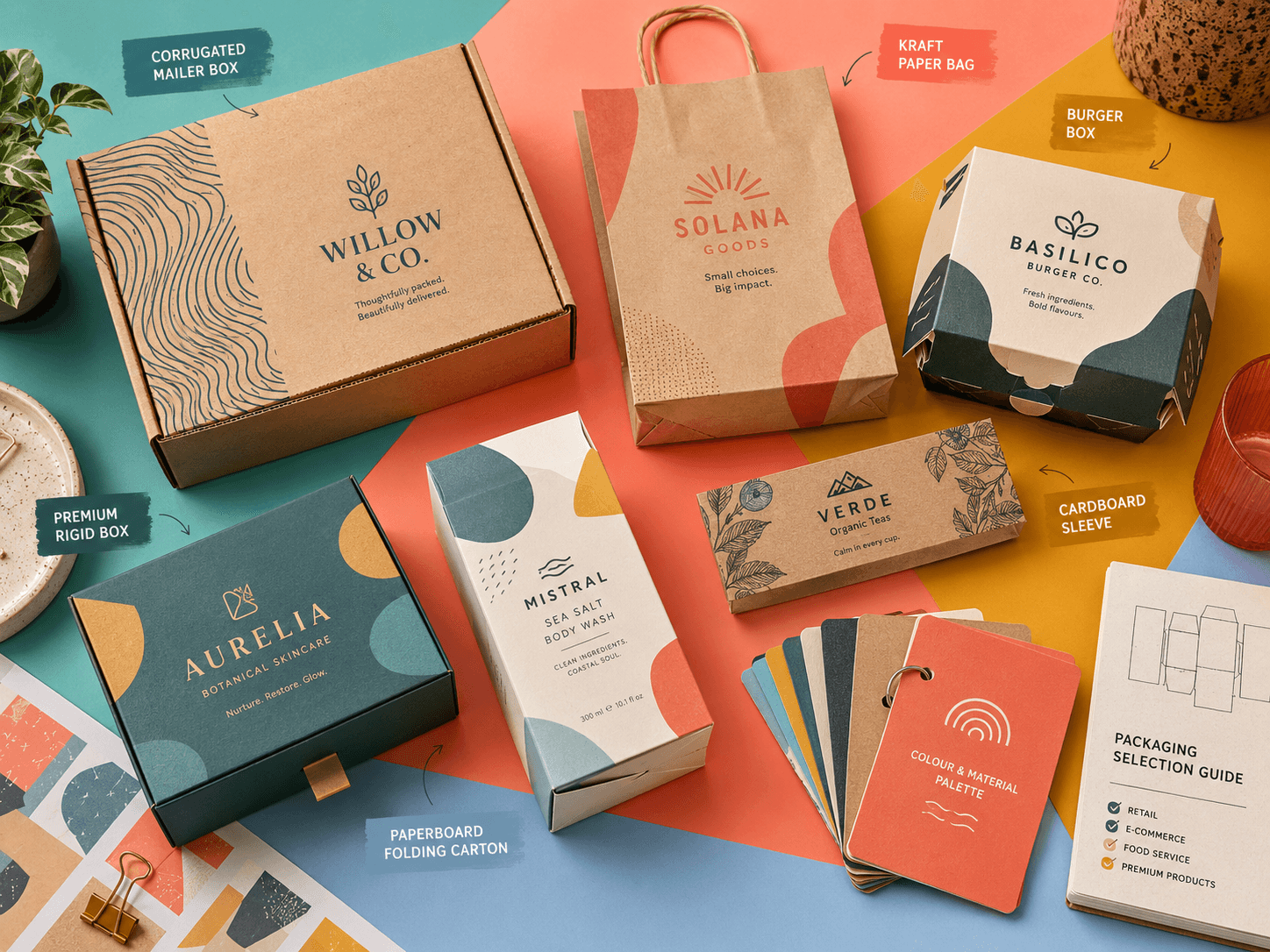
The main types of packaging boxes include folding cartons, corrugated shipping boxes, corrugated mailer boxes, rigid boxes, drawer boxes, tuck-end cartons, auto-bottom boxes, lid-and-base boxes, display boxes and gable boxes.
For lightweight retail products, folding cartons are often the most efficient choice. For ecommerce delivery, corrugated mailers usually provide a better balance of protection and presentation. Standard corrugated shipping cartons suit heavier loads and grouped products. Rigid boxes make sense when premium presentation justifies additional cost and storage. Auto-bottom structures work well when packing speed matters, while inserts and dividers can make almost any suitable outer box perform better.
The right box is not simply the most attractive or strongest one. It is the structure that protects the product, fits efficiently, works with the fulfilment operation and makes commercial sense at the required quantity.
Start With the Box's Job
Before comparing box styles, decide what journey the packaging has to survive.
This is the first filter I use because it can eliminate unsuitable structures immediately.
A carton travelling inside a master case to a retail shelf faces a very different environment from a parcel being sorted, stacked, dropped and handled individually by a courier network.
A retail product can often prioritise print quality, compact dimensions and shelf presentation. An ecommerce package has to withstand much more independent handling.
That is why I rarely recommend choosing from packaging styles purely by appearance. The same product could need one structure for retail, another for online orders and sometimes both.
Structure Comes First
The first questions should be:
These answers normally tell me whether I should begin with paperboard, corrugated board or rigid construction.
Logistics Comes Second
Once the basic material family is clear, I look at:
This is where a beautiful packaging concept sometimes stops making commercial sense.
Branding Comes Third
Only then do I start considering:
My strongest advice is simple: do not make the structural engineering compromise to protect a mood board.

Folding Cartons
Folding cartons are one of the best choices for lightweight retail packaging, but they are also one of the most frequently misunderstood box types.
They are normally manufactured from solid paperboard rather than fluted corrugated board. Think cosmetics, supplements, confectionery, small electronics accessories, skincare and similar products that need clean graphics and compact shelf presentation.
Where Folding Cartons Work Best
I like folding cartons when the product is:
Their smooth surface makes them particularly good for detailed typography, photography, Pantone colours, foil and other refined finishing.
When I Would Avoid Them
I would be cautious if the carton itself has to become the shipping container.
A folding carton containing a bottle of moisturiser might perform perfectly on a retail shelf. Put that same carton directly into a parcel network without protective outer packaging and the risk changes completely.
Paperboard does not have the cushioning and compression behaviour of corrugated fluting.
I also avoid relying on simple tuck closures for very dense products unless the structure and base have been engineered appropriately.
The mistake I see is assuming that because something is called "cardboard", all cardboard performs the same job.
It does not.
Corrugated Shipping Boxes
Corrugated shipping boxes are the workhorses of packaging.
They prioritise strength, stacking and transport efficiency rather than elaborate opening experiences.
A common example is the regular slotted carton, where top and bottom flaps meet and are normally secured with tape, adhesive or another closure.
I recommend corrugated shipping cartons for:
Their appearance can still be branded, but I would not force a utility shipping carton to perform like a luxury presentation box.
That is asking one structure to do two conflicting jobs.
Why Corrugated Board Works
Corrugated material combines liners with a fluted medium between them.
Those flutes create structure, cushioning and resistance to crushing.
The precise board specification still matters. Product weight, dimensions, stacking, handling and distribution conditions all influence whether a lighter single-wall construction is enough or whether a stronger specification is justified.
A heavier box is not automatically better. Unnecessary board adds material, bulk and cost.
Corrugated Mailer Boxes
For many ecommerce businesses, corrugated mailer boxes occupy the useful middle ground between shipping performance and customer presentation.
A roll end tuck front mailer box is a good example. Its rolled side walls and front tuck create a more structured opening than a standard taped shipping carton while keeping the protection of corrugated board.
I commonly consider mailers for:
Why I Like Mailers
They can ship flat.
That matters more than many startups initially realise.
Flat-packed packaging reduces the amount of warehouse space occupied by empty boxes. It can also make inbound logistics far more practical than bulky pre-assembled packaging.
A mailer also gives you valuable branding space on the inside lid.
For ecommerce packaging, I often prefer a restrained outside and a stronger visual moment inside. The exterior has to survive handling. The interior arrives relatively protected and becomes the customer's reveal.

When Mailers Become Wasteful
Mailers are not automatically the right choice for every ecommerce product.
A very large die-cut mailer can consume significantly more board than a simple shipping carton.
If the product is low-margin, unusually heavy or large, the extra structure may not justify itself.
The biggest mistake is using an oversized mailer simply because the brand wants one box to handle everything.
Rigid Boxes
Rigid boxes are presentation-led packaging.
They use thick board that keeps its finished shape rather than collapsing flat like a folding carton.
They are particularly effective for:
If presentation is central to the product proposition, rigid boxes can create a sense of weight and permanence that lightweight cartons cannot replicate.
Where Businesses Miscalculate Rigid Packaging
The hidden issue is volume.
Rigid packaging typically reaches the packing operation already formed. A pallet therefore holds far fewer units than it would if those boxes were supplied flat.
For a brand with limited warehouse space, that matters.
I have seen premium startups get excited about rigid packaging before calculating where several thousand empty boxes will physically live.
Rigid packaging can also require protective outer packaging for ecommerce delivery. The presentation box itself should not always be expected to absorb courier damage.
My rule is to use rigid construction because the product and commercial positioning justify it, not simply because a well-known luxury brand uses it.
Drawer and Sleeve Boxes
Drawer boxes create a deliberate reveal.
The product sits inside an inner tray that slides from an outer sleeve. They work beautifully for confectionery, cosmetics, gift sets, accessories and products where opening the package is intentionally part of the experience.
They can look excellent, but I do not recommend them automatically.
The Fulfilment Problem
Drawer structures add handling.
The inner component has to be loaded correctly, aligned and inserted into the outer sleeve. Depending on the design, other components may also need adjustment.
At low volumes, this may be completely acceptable.
At thousands of packs per day, small delays multiply.
That is why I always ask how the packaging will be packed before approving an elaborate opening mechanism.
Auto-Bottom Boxes
Auto-bottom or crash-lock cartons are excellent when packing speed matters.
The base is pre-glued during manufacturing. When the carton is opened, the bottom moves into its assembled position far more quickly than a manually locked base.
I often favour this structure for growing brands where labour is becoming a meaningful part of fulfilment cost.
You can compare several tuck, lock and bottom constructions within custom box styles and shapes before deciding which closure suits the packed product.
When Auto-Bottom Makes Sense
It becomes particularly attractive when:
A simpler carton may cost slightly less from the factory but cost more once somebody has to fold, tape and handle it thousands of times.
Straight and Reverse Tuck Boxes
Straight tuck end and reverse tuck end cartons are efficient retail structures for lightweight products.
Both fold flat, use relatively little storage space and provide useful printable panels.
They suit:
Straight vs Reverse Tuck
The difference is primarily in how the top and bottom tuck flaps are oriented.
That affects panel layout, assembly and sometimes material efficiency.
Neither structure should be chosen solely because its name sounds familiar. Product weight and base performance still matter.
If the packed item places too much pressure on a simple paperboard closure, I would move towards a stronger locking base or different structural family.
Lid-and-Base Boxes
A lid-and-base box creates a classic opening experience because the top lifts completely away from the bottom.
These can be produced as lightweight paperboard cartons or as premium rigid constructions depending on the application.
They work well for:
What I do not like is seeing unsecured lid-and-base packaging treated as a standalone ecommerce shipper.
If the lid can separate from the base, the package needs another way to stay closed during transport. That might be an outer shipper, sleeve or appropriate sealing method.
Display Boxes
Display boxes have a different job again.
They are designed not just to contain products but to help present and dispense them at retail.
Counter displays and retail-ready structures work well for products such as:
The best display structure considers what happens after the transit portion is opened.
Can staff position it quickly?
Does the display remain stable as products are removed?
Can shoppers see and reach the items?
A structure that performs brilliantly on a checkout counter may make no sense for a direct ecommerce order.
Gable Boxes
Gable boxes combine a carton body with an integrated handle.
They are useful for:
The handle is convenient because it can reduce the need for a separate carrier bag.
The trade-off is stacking.
A raised handle and shaped top make gable boxes far less efficient for palletisation and vertical stacking than regular rectangular cartons.
For handover packaging that can be a reasonable compromise. For dense warehouse storage, it usually is not.

Folding Carton or Corrugated Box?
This is one of the most common packaging decisions and one of the easiest to get wrong.
The distinction I use is straightforward:
Choose folding paperboard when presentation and retail efficiency are the primary jobs. Choose corrugated board when shipping strength, stacking and impact resistance become more important.
There are exceptions, but that is the correct starting point.
A folding carton might be the customer-facing primary pack, then travel inside a corrugated shipping case.
A corrugated mailer might perform both jobs for an ecommerce business.
A fragile premium product might use a rigid presentation box inside a protective corrugated outer carton.
Packaging does not have to be one box doing everything.
If the broader product journey is still unclear, how to choose the right packaging for your product goes deeper into retail, ecommerce, materials and product requirements.
E-Flute, B-Flute and C-Flute
The flute influences thickness, surface quality, cushioning and stacking behaviour.
I do not pick a flute from a standard list without considering the product.
E-Flute
E-flute is comparatively thin and has a dense flute profile.
I often start here for lighter ecommerce mailers where I want:
It is particularly useful when a corrugated structure still needs to look refined.
B-Flute
B-flute gives more substantial puncture resistance and strength.
I consider it for heavier products, stronger shipping boxes, certain retail-ready structures and situations where E-flute does not provide enough protection.
C-Flute
C-flute is a common direction for utility-led shipping cartons and master cases.
It provides more cushioning depth and performs well where stacking and transport matter more than highly refined print.
The correct flute still depends on the complete board specification. Flute letter alone should never be treated as a full performance specification.

Single-Wall or Double-Wall?
Single-wall corrugated board is enough for a large proportion of ordinary consumer packaging applications.
Double-wall structures add another fluted layer and another liner, creating a much more substantial board.
I reserve heavier constructions for situations that genuinely justify them, such as:
Over-specifying double-wall board can create a package that is unnecessarily bulky and expensive.
Engineering should solve the risk, not simply add thickness until everyone feels safe.
Kraft or White Board?
The choice between natural kraft and white board is both visual and technical.
Kraft gives a warmer, natural board appearance and works particularly well with restrained graphics, dark inks and designs that intentionally leave some substrate visible.
White board gives colours a more neutral base. It is generally the better direction when the artwork depends on:
Do not assume that artwork will look identical on both.
Ink interacts with the substrate underneath it.
If environmental positioning matters, verify the actual fibre source, recycled content, coatings and end-of-life characteristics rather than assuming brown board automatically proves a sustainability claim.
The Insert Can Change the Box
One of the most useful packaging lessons I have learned is that the outer box and the insert should be engineered as one system.
A heavy bottle moving freely inside a large box can strike the walls repeatedly. The obvious reaction is often to make the outer carton thicker.
Sometimes that is the wrong answer.
A well-designed internal fitment can stop the product moving in the first place.
For bottles, jars, fragile products or multi-item sets, custom product packaging allows the outer structure, dimensions and internal fitment to be designed around the product as one complete system.
Inserts and dividers can:
I would rather engineer the product position correctly than simply surround it with more empty board and loose filler.
Protection Before Decoration
This also affects budget.
If I have to choose between spending extra money on foil outside the box or using that budget to keep four glass bottles securely separated, I will protect the bottles first.
The packaging can still look premium without every available finishing process.
Broken products never look premium.

Box Size Matters More Than Most Brands Think
A box should not be as tight as physically possible.
It should be as compact as practical while leaving enough controlled clearance for the product, insert, board thickness and packing process to work properly.
That distinction matters.
A product squeezed into zero-clearance packaging can cause:
An oversized box creates the opposite problems:
Measure the Packed Product
Do not measure only the bare product if the finished pack also includes:
Measure the complete arrangement as it will actually be packed.
For small tuck cartons, a small amount of clearance can be enough. Fragile products with cushioning or shaped inserts need more.
The correct tolerance depends on the product and the structure, not a universal formula.
For a deeper sizing example, what size tuck box do I need for my product covers clearances, inserts, board thickness and physical fit testing in more detail.
Internal and External Dimensions
Always state whether dimensions are internal or external.
This sounds basic, but it causes expensive mistakes.
Internal dimensions describe the usable space available to the packed product.
External dimensions describe the finished outside size of the box.
With thicker corrugated material, the difference becomes increasingly important.
If a supplier thinks you have provided internal measurements but they are actually external measurements, the usable space can become smaller than expected.
I prefer starting with the product and required internal space, then engineering the outside dimensions from the chosen structure and board.

Once dimensions are established, the free box dieline generator can help turn length, width and height into a useful structural starting point.
Avoid the Universal Box Trap
A single box size for every SKU sounds efficient.
Sometimes it is.
Sometimes it quietly destroys margin.
Imagine an apparel business using the same large carton for a winter jacket and a single lightweight top.
The smaller product may occupy only a fraction of the available volume. The warehouse then has to add tissue or filler, the parcel consumes more transport space and the customer opens a mostly empty box.
Instead of creating ten completely different box sizes, I often prefer grouping products into sensible size tiers.
For example:
Then use inserts or packing configurations to handle modest differences inside each tier.
That gives a better balance between manufacturing volume and shipping efficiency.
Volumetric Weight Changes the Maths
Parcel costs are not always based purely on actual weight.
Carriers can also consider the space a parcel occupies.
That means a light product inside an unnecessarily large carton can cost more to send than expected.
This is why I tell buyers not to spend weeks negotiating a few pence from the factory price while ignoring centimetres of unnecessary box volume.
Right-sizing can influence:
The cheapest unit price is not necessarily the cheapest packaging system.
Print Should Match the Box
Printing methods and finishes should be selected around the material rather than added after the structure is finalised.
A folding carton gives you a very different printing surface from raw corrugated board.
A rigid box often uses a separately printed wrap.
Corrugated packaging may be printed directly or use a printed liner depending on the visual requirement.
Digital Printing
I prefer digital printing when flexibility matters.
It can make sense for:
There are fewer traditional setup requirements, which can make lower-volume production practical.
Offset Printing
Offset lithography becomes particularly attractive when quantities increase and the artwork demands highly controlled reproduction.
It is a strong choice for:
For products that need a made-to-measure structure rather than a stock format, custom boxes can be specified around dimensions, board, inserts, print and the way the product will actually be packed, displayed or delivered.
CMYK or Pantone?
CMYK is the natural choice for full-colour photography and artwork containing many colours.
Pantone becomes valuable when a specific brand shade needs tighter control.
I consider Pantone particularly important for colours that are difficult to reproduce consistently in four-colour process.
But colour also depends on material.
The same ink can look different on white coated paperboard, natural kraft and an absorbent uncoated stock.
Always evaluate colour as ink plus substrate, not just a value on a screen.
Spend Finishing Money Carefully
Special finishes should earn their place.
I like:
What I dislike is applying expensive finishes automatically.
Inside Print Can Beat Outside Flash
For an ecommerce mailer, the outer box has to survive warehouses, vehicles, sorting and doorstep handling.
That is not always the best place to put the most delicate finish.
A restrained outside combined with a distinctive printed interior can create a stronger reveal while keeping the more visually important graphics relatively protected.
Soft-Touch Is Not for Everything
Soft-touch can feel excellent on premium retail or rigid presentation packaging.
On an outer shipping carton, I am far less enthusiastic.
Scuffs, dirt and abrasion can undermine the finish before the customer experiences it properly.
Foil Needs Enough Detail
Foil stamping also has physical limitations.
Tiny type, extremely thin lines and intricate artwork can reproduce poorly if the design does not respect the process.
A finish should be designed as a production layer, not treated like an effect added in Photoshop.
Design the Artwork Around the Dieline
A dieline is mechanical geometry.
It controls the panels, flaps, cuts, creases, glue areas and closures that allow the package to become a physical object.
Do not distort it because a logo does not fit where the designer wanted it.
I have seen attractive artwork create unnecessary production problems because nobody considered:
The correct sequence is product, structure, material, dieline, then final artwork.
How to design packaging covers artwork orientation, bleed, structural allowances and production checking in much greater depth.
Fulfilment Cost Can Reverse the Decision
One of my strongest opinions is that businesses should stop evaluating packaging solely from the factory invoice.
Consider two boxes.
One costs slightly less but takes a packer close to a minute to fold, tape, fill and seal.
The other costs more per unit but opens quickly and uses an integrated closure.
At a few dozen orders a week, the difference may not matter.
At several thousand orders, it can become a major operating cost.
Watch the Packing Steps
Count the actions required to complete one package.
Does the operator have to:
None of these steps is automatically bad.
The problem comes when nobody calculates what happens when each step is repeated thousands of times.

Packaging Should Change as the Business Scales
The structure that works for a startup does not have to remain the structure used five years later.
I have seen this repeatedly.
At low volume, founders can tolerate complex manual packing because their own time is not being recorded as a fulfilment cost.
As the business grows, that hidden labour becomes visible.
This is when I start thinking about:
Packaging should support growth rather than become the thing slowing the warehouse down.
Case Study: Luxury Skincare Without the Rigid Box
One premium skincare startup initially wanted thick rigid lid-and-base packaging with a fitted foam interior.
Visually, it suited the product.
Operationally, it did not.
The company was selling entirely online and working from limited fulfilment space. Several thousand formed rigid boxes would have consumed a disproportionate amount of storage before a single order was packed.
There was also another problem: the pristine rigid presentation box would still need protection during parcel delivery.
I recommended moving the structural spend into a high-quality E-flute corrugated mailer, paired with a shaped paper-based insert. The outside remained restrained while the interior carried stronger branding.
The result was not a downgrade.
It was a better match between luxury presentation and ecommerce reality.
The boxes could arrive flat, the insert controlled the product and the outer structure was more suited to parcel handling.
That project reinforced something I still believe: premium packaging is not defined by how thick the box is. It is defined by how intelligently the complete experience has been designed.
Case Study: Glass Bottles Needed Corrugated Protection
Another business was preparing a three-bottle gourmet condiment set.
The initial concept was a beautifully printed folding carton because the brand wanted sharp retail graphics.
The problem became obvious once the actual filled glass bottles were considered.
Three dense glass containers created far more load than the paperboard concept was comfortable carrying. The bottles could also contact each other inside the pack.
Instead of simply making the folding carton thicker, I moved the structure towards a corrugated pack with individual dividers between the bottles.
That solved two problems simultaneously.
The corrugated outer structure carried the load more confidently and the dividers prevented glass-on-glass contact.
The graphics had to adapt slightly to the new material, but protecting the product mattered more than preserving the original carton concept.
Case Study: The Box Was Slowing the Warehouse
A growing apparel business wanted drawer-style packaging with a ribbon pull because the presentation looked distinctive.
At low volume, that would have worked.
But daily order numbers were already climbing quickly.
When we broke the packing process into individual actions, the drawer system created too much repetitive handling. The tray had to be prepared, the garment positioned, the sleeve aligned and the complete package secured.
I recommended a faster folding structure with an efficient base and simpler closing method.
The box became less theatrical but far easier to pack repeatedly.
That is the type of decision that can feel like a design compromise until you watch a fulfilment team repeat the same action all day.
Then it becomes an operational advantage.
Case Study: One Box Size Was Costing Too Much
An accessories retailer had tried to simplify purchasing by using one large shipping carton for almost every order.
The logic seemed reasonable: one SKU, one artwork file and larger purchasing volume.
The problem was that many orders contained only one or two small products.
Most of the carton became empty space.
More filler was needed. Parcels occupied more volume. Small orders looked underwhelming when opened.
Rather than producing a unique box for every product, I recommended dividing the most common orders into three packaging sizes.
That retained purchasing simplicity while significantly improving fit.
This is the balance I prefer: standardise intelligently, not blindly.
Common Box Selection Mistakes
After working with packaging buyers, the same problems appear repeatedly.
Confusing Folding Cartons With Shipping Boxes
A thin paperboard carton may look substantial on screen.
That does not make it suitable for direct courier handling.
Always separate retail presentation from shipping protection.
Ignoring Packed Weight
Two products can have identical dimensions and require completely different packaging because one is much denser.
A lightweight cosmetic bottle and a glass jar can put very different loads on the base of a carton.
Assuming Bigger Means Safer
Extra empty space does not automatically create protection.
Uncontrolled movement can make damage worse.
Use only the clearance required for purposeful cushioning, inserts or packing.
Buying Luxury Before Solving Logistics
Rigid board, foil and soft-touch finishes can be worthwhile.
They should not come before storage, delivery, product protection and packing requirements.
Removing the Insert to Save Money
Sometimes the insert is the component doing the most useful work.
Removing it can create product movement, damage and a poorer presentation while forcing the outer carton to do more.
Ignoring Assembly Time
The box price is only part of packaging cost.
If a complicated structure slows the packing line, the business continues paying for that decision on every order.
Five Rules I Use for Choosing a Box
After years of seeing what works and what causes problems, these are the five principles I would keep even if everything else had to be simplified.
Let Distribution Determine the Base Material
Find out how the product travels before falling in love with a structure.
A parcel-delivery environment, palletised retail distribution and customer handover each create different packaging requirements.
The transport ecosystem is part of the design brief.
Protect the Product Before Buying Finishes
If the budget is limited, spend first on the structural elements that stop damage.
A well-designed insert, divider or stronger base can create more business value than decorative embellishment on an unsuitable box.
Calculate the Fulfilment Clock
Do not compare factory prices without comparing packing time.
A structure that saves pennies at production but adds repeated manual work can become much more expensive as volume grows.
Right-Size Before Negotiating Pennies
Before chasing a lower unit price, make sure the dimensions are efficient.
Reducing avoidable empty space can influence board consumption, filler, storage and delivery costs at the same time.
Consolidate SKUs Intelligently
Do not automatically create a different box for every product.
Group compatible products into practical size families where possible, then use inserts or controlled internal packing to handle modest differences.
Manufacturing efficiency and right-sizing have to work together.

Which Box Should You Choose?
If you remember only one thing, make it this:
Choose the box around the product journey, not around the packaging photograph you want to create.
Start with the delivery environment.
Confirm packed weight, dimensions and fragility.
Choose the structural family.
Control movement.
Check storage and fulfilment.
Then decide how much presentation the product and margin justify.
For businesses needing a broader decision framework before committing to a structure, how to choose the right packaging for your product is a useful next step for weighing product fit, material and delivery requirements.
If the finished structure needs to be produced around exact dimensions, custom boxes can be specified around board, inserts, print and the way the product will actually be packed, displayed or delivered.
The biggest misconception I wish more packaging buyers understood is that packaging is not simply a marketing canvas waiting for a logo.
Packaging is an interconnected extension of logistics, labour, product protection and margin.
When those parts work together, the box can still look outstanding.
It simply looks outstanding for the right reasons.