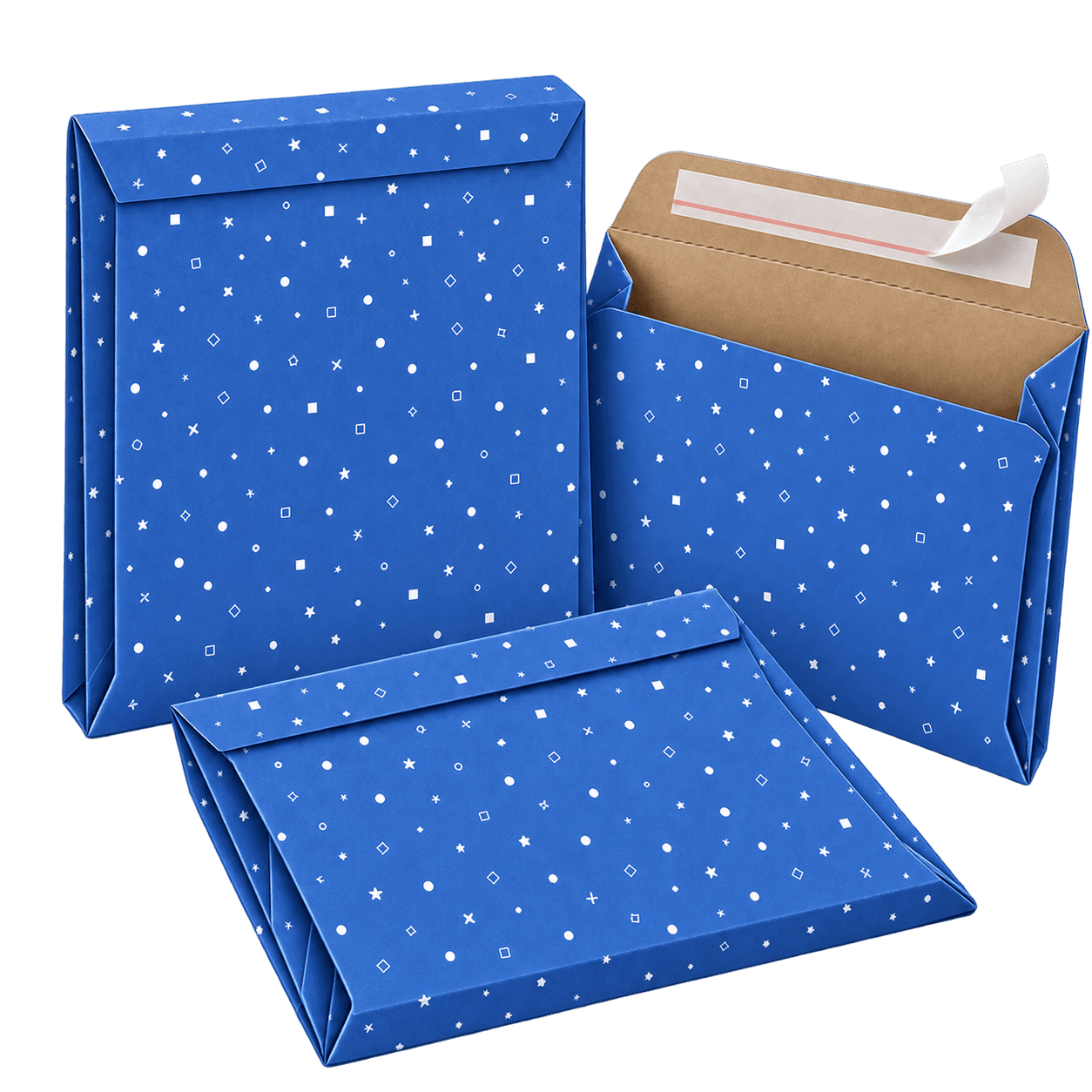
The right structure depends on how the pack will be filled, sealed, opened and handled.
Peel-and-Seal Envelopes
A peel-and-seal adhesive strip creates a quick, clean closure without separate tape.
The protective liner stays over the adhesive until the envelope is packed. Your team removes the liner, folds the flap into place and presses it closed.
This works particularly well for repeat packing where speed matters. The adhesive position can be planned around the flap dimensions so that the seal sits neatly without interfering with artwork or the contents.
Tear-Strip Envelopes
A tear strip gives the recipient a clear opening point.
Instead of pulling apart the glued flap or cutting into the pack, the customer follows the perforated strip to open the envelope in a more controlled way.
For branded mailouts, membership packs, printed kits and ecommerce orders, this can make a simple paperboard structure feel considerably more considered.
The strip should be planned as part of the dieline rather than added after artwork is finished.
Seal and Tear Together
A peel-and-seal strip and tear strip can be used in the same envelope when fast packing and clean opening both matter.
The adhesive secures the outgoing package. A separate perforated section gives the recipient an intentional way into it.
This combination is particularly useful for businesses sending the same format repeatedly because it simplifies both sides of the experience: packing for your team and opening for your customer.
Pocket Envelopes
An extra pocket can separate cards, leaflets, vouchers, instructions or another flat component from the main contents.
For example, the main section might hold a product or printed set while a smaller slip pocket keeps an information card in a fixed position.
The pocket depth, opening direction and board thickness should be settled before the main dieline is approved. Small dimensional changes can affect both fit and how easily the card can be removed.
Gusseted Envelopes
When the contents have more thickness than a completely flat item, a gusset can create extra capacity at the sides or base.
This can work for thicker document sets, booklets, product samples and grouped printed materials.
A gusset is still not a replacement for a protective corrugated box when the product is fragile or heavy, but it can bridge the gap between a flat envelope and a deeper mailing carton.