E-Flute or B-Flute? Start with What Your Parcel Must Survive
E-flute is often the better starting point for lightweight, presentation-led mailer boxes. B-flute is worth considering when the contents are heavier, more fragile or need a more substantial outer wall for delivery. Neither is automatically the right choice for every product. The weight, dimensions, internal support and journey matter as much as the letter on the board specification.
That distinction has practical consequences. A beautifully printed mailer that cannot protect its contents is a poor packaging decision. Equally, choosing the thickest board for a small, durable item can add unnecessary bulk without solving a real problem. In our experience, the choice becomes clearer when the board is selected around the actual product rather than an attractive sample.
For UK businesses choosing custom mailer boxes, the useful question is not simply which flute is stronger. It is which complete box construction gives the product the right balance of protection, print quality, usable space and cost.
What Actually Changes Between E-Flute and B-Flute?
Both Are Corrugated Board, but the Internal Waves Are Different
Single-wall corrugated board has a wavy paper medium between two flat liners. The shape and spacing of that medium form the flute. E-flute uses a finer, lower profile; B-flute uses a taller profile with wider spacing. That affects the wall depth, the way panels fold, how the surface behaves during printing and how the finished box responds to handling.
As a practical production reference, finished E-flute board is often around 1.5 mm thick and B-flute around 3 mm. Those are approximate values, not guaranteed specifications. FEFCO's indicative flute heights are around 1.2 mm for E and 2.4 mm for B, excluding the outer liners. The mill's papers and converting process determine the actual finished caliper.

E-flute's compact construction often gives smaller mailers a neat, defined shape. B-flute creates a deeper wall that can help with cushioning and rigidity, particularly when a mailer becomes larger or the packed contents exert more pressure on the panels.
A Flute Letter Is Not a Strength Certificate
One mistake is to compare two boxes by flute alone. A strong E-flute board with suitable liners can perform better in a particular test than a poorly specified B-flute board. Liner grade, paper weight, moisture exposure, flute direction, box geometry and the quality of the folds all influence the outcome.
For a heavier dispatch, ask about the complete board specification and suitable compression or transit testing rather than assuming that B-flute can carry any given load. If a product is especially heavy or sensitive, neither single-wall option may be enough. The decision could instead involve a stronger grade, another structure or a double-wall construction.
When E-Flute Makes More Sense
Lightweight Cosmetics and Smaller Branded Mailers
E-flute is a sensible starting point for lightweight beauty products, sample kits and compact accessories when the contents are held securely. Its finer corrugation can produce a relatively flat outer surface, which is helpful when the package needs sharp artwork and a tidy retail-like appearance.
A small lip balm kit or a carefully secured makeup set, for example, may not need the bulk of B-flute. But weight is not the only factor. A glass serum bottle can be light and still highly vulnerable to impact. In that situation, examine the cosmetic mailer box together with its insert before committing to E-flute.
Clothing and Soft Goods That Do Not Need Heavy Cushioning
Folded T-shirts, scarves and similar soft goods are often suitable candidates for E-flute. These products usually place fewer demands on shock protection than glass, ceramics or delicate gift items. A clean fold, consistent print and a slim packed profile may matter more than adding wall depth.
That does not make every apparel order an E-flute job. Shoe sets, accessories with hard components or several garments packed together change the weight and handling requirements. The priorities for retail and apparel packaging should follow the actual order rather than the product label alone.
Printing That Depends on Crisp Panels
For direct printing onto corrugated board, E-flute's finer structure can help create a smoother-looking print surface and more defined fold edges. This advantage matters most for fine typography, intricate graphics and broad areas of solid colour. It is less decisive when the finished surface is created by mounting a separately printed sheet onto the board, which is considered later.
When B-Flute Earns Its Extra Depth
Heavier or Fragile Items Going Directly to the Customer
B-flute is often the safer option to evaluate for deeper gift boxes, heavier household products and fragile multi-item orders. Its thicker section can give the panels more substance and provide additional scope for cushioning. That is particularly relevant when the branded mailer itself is the outer parcel exposed to courier handling.
A good corrugated mailer box should still be designed to fit its contents. Extra thickness does not prevent a ceramic object from rattling against another item or stop a glass bottle striking an unprotected corner.
Where movement is the failure point, accurately sized inserts and dividers can contribute more than a flute change on its own. Protection is a system: outer board, box size, product orientation, internal restraint and closure all work together.

Larger Mailers, Product Bundles and Repeat Dispatch
As a box grows wider or deeper, unsupported panels can flex and packing loads may be less evenly distributed. B-flute may provide useful rigidity for larger mailers, heavier bundles or parcels that are stacked before collection. The actual result depends on board grade and box design, so it should be checked rather than assumed.
The decision becomes more consequential for ecommerce and subscription packaging, where boxes must survive repeated packing routines and a variety of product combinations. If a single mailer serves multiple SKUs, test the heaviest and most fragile representative order, not just the smallest one.
A London Gift Brand That Switched from E-Flute to B-Flute
A London-based gift brand came to us using E-flute mailer boxes for items that were both fairly fragile and slightly heavier than their packaging choice suited. The boxes had an appealing presentation, but the priority was to make the deliveries more dependable. After discussing the products and their handling needs, we recommended moving to B-flute.
The customer followed that recommendation. They subsequently reported better protection during delivery, fewer damaged products and more confidence in the packaging. They also told us their sales had increased. We have not treated that sales improvement as a measured consequence of the flute change: other factors can influence sales, and no controlled comparison was carried out.
What the experience does show is why a material decision should follow product risk. The original E-flute choice was not inherently bad material. It was a poorer match for those particular gifts. A thicker B-flute wall was a more appropriate direction for their needs, alongside the fit and handling considerations that any fragile parcel requires.

This is an important distinction from simply recommending stronger cardboard whenever damage is reported. Where breakage comes from movement or contact inside the box, the answer may involve the insert, not just the wall. The practical checks for fragile products, box strength and internal support help separate those causes.
Does E-Flute Really Print Better?
Direct Print and Fine Artwork
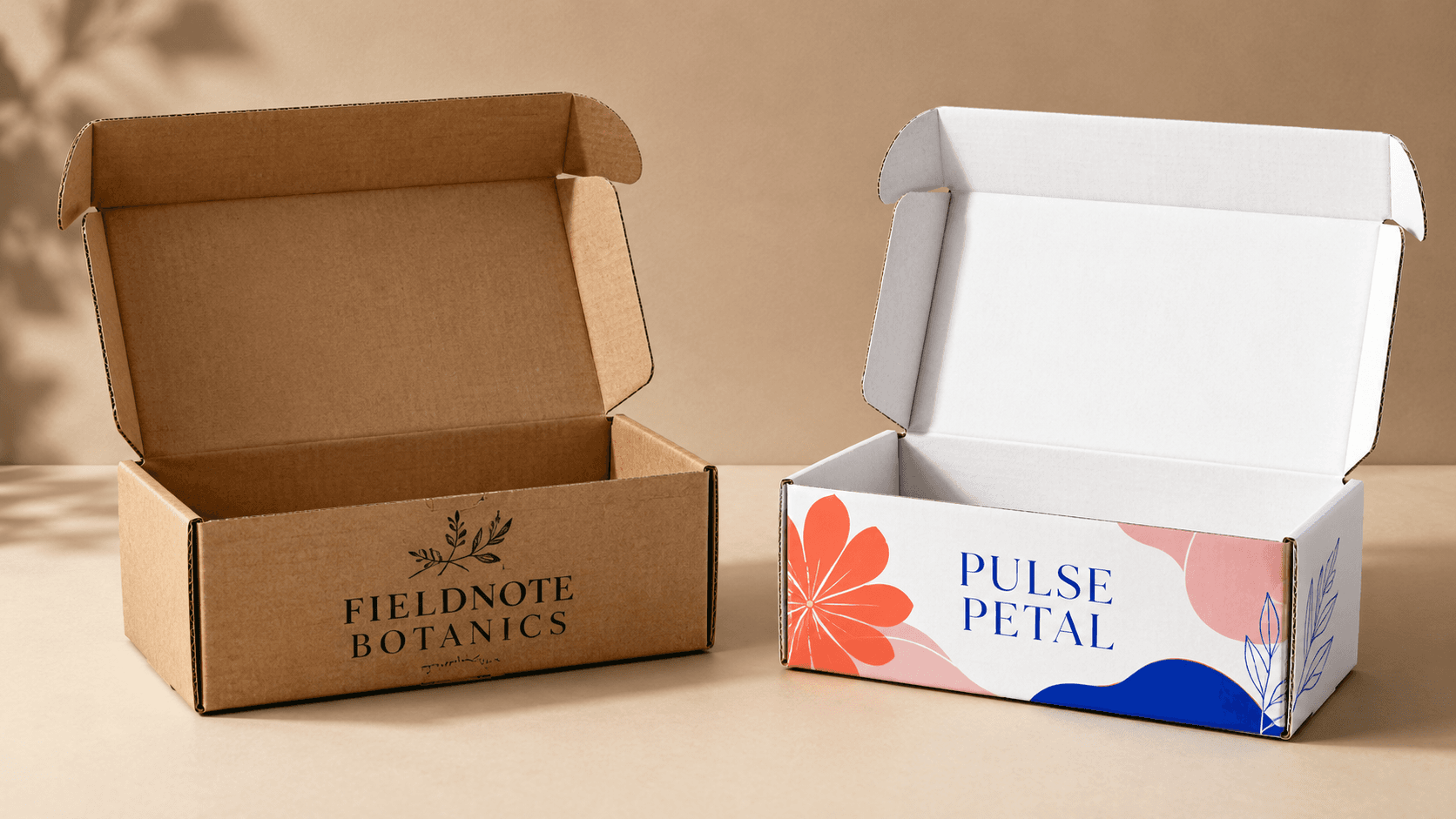
When ink is applied directly to the corrugated surface, the underlying flute can affect the appearance of large solid areas and small details. E-flute generally gives a flatter surface for this kind of work. On some coarser board grades, the flute pattern may become visible in the print, especially across broad colour panels.
That is one reason E-flute can be attractive for a premium-looking lightweight mailer. Yet the actual result also depends on the liner colour, paper smoothness, printing process and artwork. White-faced board and natural kraft-faced board will not reproduce every colour in the same way.
Mounted Printed Sheets Change the Decision
A premium design can also be printed onto a separate sheet and laminated to the corrugated construction. With this approach, both E-flute and B-flute can achieve refined graphics because the printing surface is not simply the exposed corrugated liner. The flute choice can then be driven more heavily by the required protection and dimensions.

If sharp branding and a stronger parcel are both important, evaluate the construction and the custom printed boxes as one specification. It is also useful to understand the production differences behind digital and offset packaging printing, since print method and flute profile answer different questions.
An important commercial point: selecting B-flute does not mean accepting poor branding, and selecting E-flute does not guarantee flawless printing. Ask to review the actual board, liner and print process before approving large quantities.
Cost, Storage and Postage: What Changes After the Flute?
The Packed External Size Matters
A thicker board occupies more room in the finished construction. If two mailers have the same internal dimensions, the B-flute version will generally be thicker externally. The difference is not always a simple addition of two wall thicknesses: rolled sides, overlapping panels and lid construction can change the measurement.
That can matter when a retailer works to a postal depth limit or packs a high number of parcels into an outer case. Recheck the fully assembled, filled and closed box rather than assuming the same postage size after changing the flute. The distinction between internal and external box measurements is particularly important when a few millimetres can alter a service band.

The Lowest Price Per Box Is Not Always the Lowest Cost
E-flute often allows a compact, lighter construction, while B-flute uses a deeper section. It is tempting to assume one must always cost less, but the price also depends on paper grade, dimensions, order quantity, printing, tooling and finishing. Actual quotes should be compared on equivalent specifications.
Storage can matter too. Flat-packed B-flute mailers may occupy more space for the same box footprint and count. But an apparently cheaper or slimmer choice becomes expensive if it leads to damaged goods, replacements or extra packing materials.
For custom product packaging, the right cost question is what the finished packaging needs to achieve, not how little cardboard can be used in isolation.
Four Common Mistakes When Choosing a Flute

The most frequent error we encounter is a mismatch between material and actual product needs: a light board is chosen for a heavy item, or a fragile order is judged mainly by how its packaging looks. Getting the product details right at the beginning is usually a better starting point than adjusting the flute after the first batch has been shipped.
How to Choose Before Committing to a Bulk Order
If the decision is close, make it using evidence from the product and its intended journey. There is no need to specify a flute before the most important facts are known.

A free 3D mockup can help you assess the shape, branding and assembly concept, but it does not prove that the package will protect a fragile product. For higher-risk orders, a physical fit check or transit trial is more informative. Sample examples from previous work may be available, while a fully bespoke pre-production sample is a paid option.
If the proposed single-wall board cannot meet the job, do not force an E-versus-B answer. A different corrugated grade, EB double-wall board, an insert or a stronger shipping box structure may be more suitable. The objective is dependable delivery and a worthwhile unboxing experience, not loyalty to one flute letter.
A Better Mailer Starts with a Better Specification
For a lightweight cosmetic kit or a soft apparel order, E-flute may give the right combination of compactness and clean printing. For a heavier, fragile gift set, B-flute may be the more sensible first option. The London customer experience reinforced the value of matching board strength to the real product, while the final decision still requires attention to fit, inserts and shipping conditions.
Share the product dimensions, packed weight, fragility, quantity and any existing artwork with Custom Packly. The team can recommend an appropriate flute and mailer structure, prepare a free 3D mockup and discuss whether a physical sample is worthwhile before a bulk order.