Skip to content
Details

Custom Bottle Shipping Boxes

Bottle Shipping Boxes are built to hold bottles more securely in transit with corrugated outer strength and organised internal spacing. They suit glass, plastic and mixed bottle packs where breakage control, upright packing and cleaner dispatch all matter.

Bottle Separation Starts at the Shoulder

The first damaging contact in a multi-bottle case often happens where the bottle is widest: the shoulder or body strikes the next bottle as the carton is tilted, lifted or set down. Stronger outer corrugated cannot prevent that contact if the bottles are free to move inside it.

Custom Bottle Shipping Boxes solve the transit job as a system. The outer case carries the combined filled weight and stacking pressure, while dividers, pads or bottle-specific supports keep individual containers apart. That distinction matters for wine, spirits, oils, sauces, home fragrance, cosmetics and other bottled products because the bottle shape, closure and number packed together can change the internal layout completely.

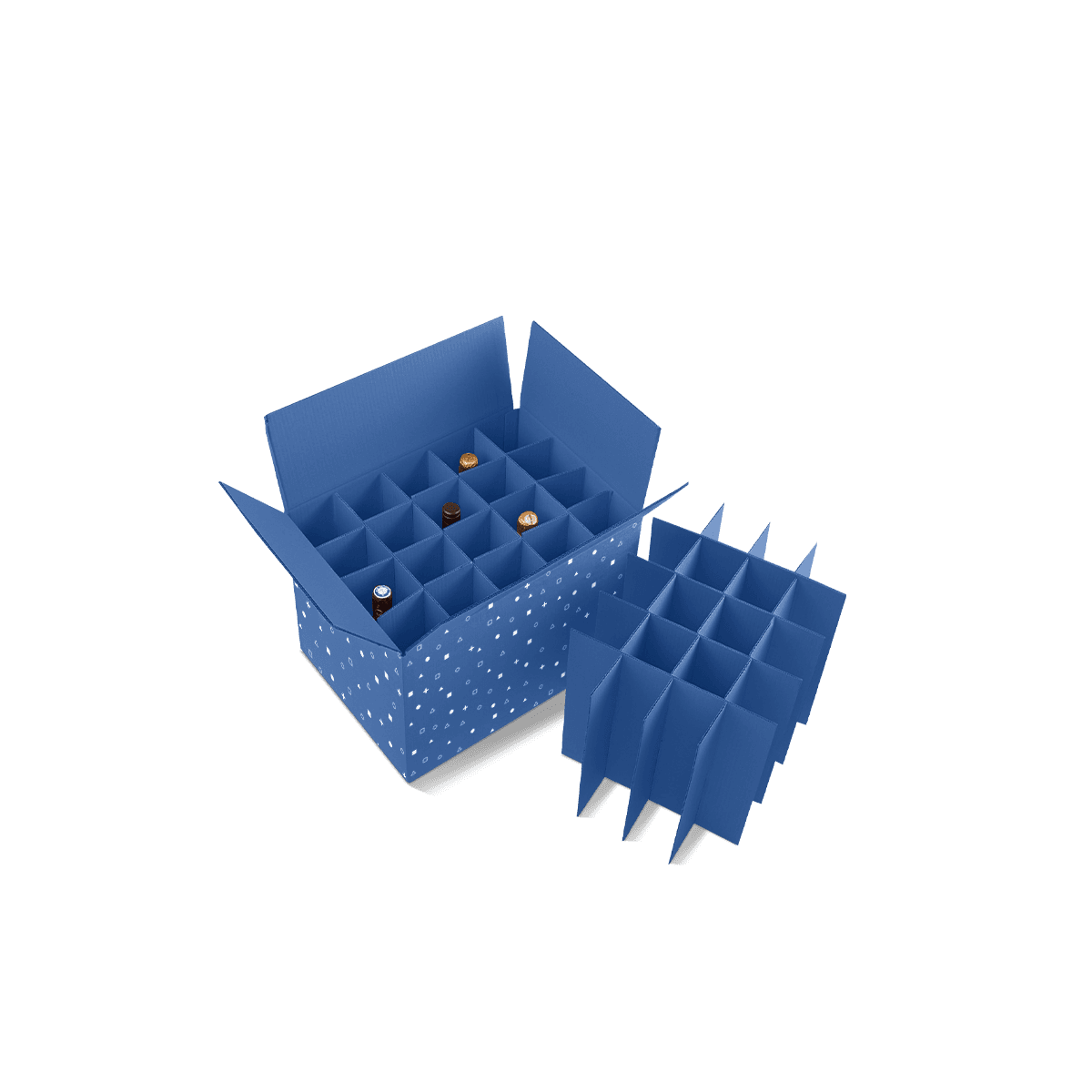
For multi-bottle shipments, separation is normally the first internal decision. Bottle Dividers can create individual cells around bottle diameter and filled weight rather than relying on loose filler between glass surfaces.

Shoulder Diameter Can Matter More Than the Base

A bottle with a narrow base and broad shoulder may contact its divider differently from a straight-sided bottle. Measuring only the base diameter can create a cell that looks correct at bench level but becomes too tight or too loose higher up.

Use the widest relevant point of the filled bottle when setting the cell. Allow enough clearance for practical loading without leaving enough lateral travel for glass-to-glass contact.

Mixed Shapes Need More Than Equal Squares

A regular grid works well when every bottle has similar dimensions. Mixed bottles can create a different problem: one tall narrow bottle may move inside a cell sized for a shorter, wider container.

Where different SKUs share one case, the divider layout should be planned around the actual combination rather than assuming identical cells are automatically efficient.
Cell Size Comes From the Filled Bottle

Bottle transit dimensions should be taken from the product as it will ship, not from an empty container specification. Liquid weight, labels, sleeves, pumps, caps and secondary wraps can change how the bottle sits and what parts need clearance.

A custom cell should restrain movement without gripping the bottle so tightly that staff have to force it into place.

Labels Need Scuff Clearance Too

A glass bottle may survive contact while a printed or coated label does not. If presentation on arrival matters, divider edges and neighbouring bottles should not rub repeatedly against decorated surfaces.

That does not mean adding generous empty space. It means controlling where the divider contacts the bottle and leaving practical clearance around surfaces that should remain clean.

Closures Change the Finished Height

Corks, screw caps, pumps, droppers and spray heads can add very different amounts of height above the bottle shoulder. The outer case should be sized around the complete filled and closed container.

A divider that controls the body but leaves the closure exposed to the top panel can transfer pressure into the most vulnerable part of the pack. Neck and closure clearance therefore belong in the same specification as the cell dimensions.

Vertical Travel Is a Separate Risk

Cell dividers mainly control side-to-side movement. They do not automatically stop a bottle moving upwards and downwards when the carton is tipped or inverted.

That is why a bottle can feel secure while the open carton is sitting on a bench and still move significantly once the package changes orientation.

Headspace Should Have a Defined Purpose

Consider six 500 ml glass oil bottles, each approximately 70 mm in diameter and 245 mm high, packed in individual corrugated cells. Side contact is well controlled, but the outer case leaves roughly 28 mm of unused space above the screw caps.

Changing to heavier outer board would not remove that vertical travel. Bringing the internal height closer to the finished bottle height, or using an appropriate top pad or stabilising component, would control movement in the direction the dividers do not.

The practical improvement is a bottle set that remains more consistently positioned when the case is lifted or turned. Each component has a separate job: the cells separate the bottles and the vertical control limits upward travel.

The same diagnostic principle is covered in fragile product packaging: outer strength and internal restraint solve different failure modes.

Orientation Marks Are Not Restraint

“Keep upright” or handling marks can communicate the intended orientation, but the packaging still needs to protect the bottles when the case is tilted during normal handling.

Do not use printed instructions as a substitute for physical control. The packed system should not depend on every person in the delivery chain keeping the carton perfectly vertical.

Six Bottles Behave Like One Loaded Case

A multi-bottle shipment is not six independent bottle problems. Once the case is closed, the combined filled weight affects the base, walls, closure and stacking behaviour of the outer carton.

The corrugated specification should therefore follow the complete loaded case.

Filled Weight Changes the Board Decision

An empty bottle may seem light enough for a modest outer case. Several filled glass bottles together can create a very different load.

Corrugated Shipping Boxes cover how flute, wall count, dimensions and transit demand work together. Bottle shipping uses those same material principles, but adds the need for cell separation and vertical control.

Double Wall Should Solve an Outer-Case Need

Double Wall Shipping Boxes can make sense when the complete bottle case needs more rigidity or compression support.

Do not choose double wall simply because the contents are glass. If the outer carton remains stable and the bottles are damaging each other internally, the divider or fit is the more relevant problem.

A free sample is useful once the likely outer case and internal layout are defined. Test it with the actual filled bottles, closures and labels rather than empty containers.

The Base Carries Concentrated Bottle Loads

Each bottle transfers weight through a relatively small footprint. In a multi-bottle carton, those concentrated loads repeat across the base in a grid.

A flat, well-supported bottom helps the bottles remain upright and prevents one cell sitting lower than another.

Pads Can Spread the Load

A base pad can help distribute concentrated pressure and provide a consistent surface beneath the divider set. It is particularly useful when filled bottles are dense or the outer case has a large footprint.

The pad should fit cleanly without interfering with the flap closure. Adding one automatically to every bottle case is unnecessary; it should solve a load or stability requirement.

Leaning Bottles Usually Signal a Fit Problem

If one bottle consistently tilts inside its cell, the cause may be excess clearance, an uneven base, a divider that is too low or a mismatch between the cell geometry and the bottle profile.

Adding loose filler around the top can hide the symptom without creating a repeatable packing method. Inserts and Dividers can be planned around the same outer case when the internal system needs more than a simple grid.

Divider Height Has a Job

Full-height and partial-height dividers do not behave identically. The useful height depends on where bottles are most likely to contact each other and how much support the divider needs to provide.

A divider that finishes well below a broad bottle shoulder may allow upper sections to touch even though the bases remain separated.

Higher Is Not Automatically Better

Extending every divider to the very top of the carton can add material and slow assembly without improving protection if the bottle geometry does not require it.

The divider should reach the contact zone that needs separation while leaving closures, necks and loading access sensible. The simplest structure that consistently prevents bottle contact is usually preferable to an elaborate internal build.

Dividers Are Separation, Not Universal Cushioning

Corrugated cells can stop bottles striking one another and can contribute internal stiffness, but separation is not the same as impact cushioning.

If a bottle is unusually shock-sensitive or has a vulnerable closure, another protective component may be needed. The correct answer follows the failure risk rather than treating every glass shipment as identical.

Pack Count Changes the Carton Footprint

One, two, six and twelve bottles create different shipping problems. The number of bottles changes the case footprint, total weight, divider grid, packing time and the way the shipment stacks.

The pack count should therefore be decided with the sales and fulfilment operation, not added after the box dimensions have already been chosen.

Single Bottle Packs Need Different Logic

A single bottle does not need cell-to-cell separation. Its main internal requirement is controlled positioning so it cannot strike the carton walls or load a vulnerable closure.

A cradle, wraparound support, end pads or another bottle-specific structure may make more sense than adapting a multi-cell divider to a one-bottle shipment.

Multi-Bottle Matrices Affect Pallet Use

A 2 × 3 bottle layout creates a different case footprint from a 3 × 4 arrangement. For wholesale or recurring pallet shipments, that external footprint can influence how efficiently cases stack and move through storage.

MOQ starts from 100 boxes, which gives a new bottle count or launch enough room to establish the right matrix without forcing every SKU into a large initial packaging commitment.

If the outer case itself needs to change around pallet movement, heavier loads or another transit requirement, Shipping Boxes sets out the available structural directions.

Divider Assembly Must Stay Repeatable

An internal system that protects bottles well but takes too long to assemble can become expensive at volume. Slotted partition pieces should be easy to identify, interlock and place inside the carton in the same orientation each time.

Packing speed becomes increasingly important for breweries, drinks producers, cosmetics companies, home-fragrance brands, wholesalers and fulfilment operations running repeated bottle shipments.

Flat Components Save Space but Add a Task

Divider sets can often be stored flat before use. That reduces packaging storage volume, but somebody still has to assemble them.

The commercial balance depends on volume. For a small launch, manual assembly may be entirely reasonable. At larger scale, component count and assembly sequence deserve closer attention because a few extra movements are repeated across every case.

Where repeat bottle cases and divider sets would occupy too much packing-floor space, warehousing and scheduled deliveries can separate the efficient production quantity from the amount held on site.

The Bottle Should Drop Into Position Cleanly

If staff have to flex divider walls, force bottles past narrow cells or repeatedly correct the grid after loading, the specification is not ready.

The internal layout should make the correct bottle position obvious. A free 3D mockup can help review the planned geometry, while physical sampling confirms the friction, clearance and assembly behaviour that a screen cannot show.

Transit Print Has Two Audiences

Bottle shipping cartons can carry branding, but warehouse and courier information may be just as important as customer-facing graphics.

SKU references, bottle count, orientation marks and destination labels should remain easy to read after the box is sealed.

Keep Label and Tape Areas Usable

Do not place essential graphics where sealing tape or courier labels will routinely cover them. The final artwork should reflect the packed carton, not only the flat dieline.

Premium offset printing can support more detailed branding where the case is customer-facing. For wholesale transit, simpler print may make the operational information clearer.

Handling Marks Support, They Do Not Guarantee Handling

Fragile or upright symbols communicate how the case should be treated. They cannot guarantee that the parcel will never be tilted or impacted.

The structural system should therefore protect the bottles independently of the printed instruction. Print is useful communication, not a replacement for correct bottle spacing and outer-case strength.

One Bottle Matrix May Cover Several SKUs

A shared bottle case can simplify stock when several products use genuinely similar container geometry. Bottles with the same diameter, overall height and closure profile may be able to use one cell layout even when the label, colour or contents change.

The saving disappears if the shared case creates excessive clearance around smaller bottles or pressure on taller closures. Standardisation should follow physical compatibility, not the desire to reduce carton codes at any cost.

For established multi-SKU programmes, Bulk Custom Boxes can support repeat quantities around approved bottle matrices.

Guaranteed 4–6 working day production and delivery can support replenishment once the specification is settled. Custom Packly can also support the outer carton, bottle dividers, dieline, artwork and repeat production as one packaging system rather than leaving the case and internal structure to be resolved separately.

When the bottle count, geometry and transit arrangement are known, request a custom packaging quote around the complete loaded case. That gives the outer board and internal cells one shared job instead of treating them as separate packaging purchases.

FAQs

This style suits both glass and plastic bottles, but it is especially valuable for glass because separation and impact control matter more. It also works well for liquids with pumps, droppers, caps or spray tops that change the packed height. The most important point is to size the transit case around the filled bottle, not the empty container, so the final fit reflects real shipping conditions.

They are the better option when bottles need controlled spacing and upright support rather than an open interior. A standard corrugated shipper can work for simpler jobs, especially where secondary wrapping or loose filler is acceptable. If the aim is cleaner packing, less bottle movement and more repeatable protection, the bottle-specific transit case is usually the stronger route.

Not always, but many bottle shipments perform better with them. Single bottle packs may only need pads or a closer internal fit, while multi-bottle orders usually benefit from dividers, bottle cells or partition inserts. The right choice depends on bottle material, weight and pack count. If glass bottles are travelling together in one case, separation should usually be treated as essential rather than optional.

Confirm bottle diameter, overall filled height, closure type, packed weight and the number of bottles per case. It also helps to check whether the bottles must remain upright, whether labels need scuff protection and whether dividers, pads or cradle inserts are required. A packed sample is worth testing because a small change in neck height or bottle spacing can affect the whole case layout.

Yes. They can stay plain for transit-first use or carry branding, handling guidance and stock details. Many businesses choose simple print so the case stays practical for warehousing while still looking organised on arrival. If the shipment is customer-facing, it is worth balancing outer branding with clear bottle handling instructions and orientation marks where needed.

Process

How it works

Your Packaging Journey, From Idea to Production and Delivery

01

Tell Us Your Specs

Custom packaging boxes

Tell Us Your Specs

Provide size, quantity, printing, and finishes.

02

Get a Fast Quote

Custom packaging boxes

Get a Fast Quote

Instant transparent pricing, no hidden fees.

03

Design and Approval

Custom packaging boxes

Design and Approval

Artwork checks, revisions, and final sign-off.

04

Produce

Custom packaging boxes

Produce

Expert manufacturing to meet deadlines.

05

Ship to Your Door

Custom packaging boxes

Ship to Your Door

Hassle-free, flexible delivery options.

Get Your Quote for Custom Bottle Shipping Boxes

Share your product details, dimensions, quantity and artwork needs. We’ll help choose the right packaging style and send a clear quote.