Skip to content
Details

Custom Multi Depth Shipping Boxes

Multi Depth Shipping Boxes let one corrugated case adapt to more than one pack height. With pre-scored depth lines, they help reduce stock variation, tighten product fit and make dispatch more efficient when order sizes change.
Dieline preview

Generate a Multi-Depth Boxes Dieline

Use custom dimensions to view the dieline for this box style and plan artwork with more confidence.

Bleed
Crease
Trim

No preview available

Multi-Depth Boxes

Calibrated controls

Current size300 × 200 × 200 mm
Preview scale100% centered
StateValidated
Next Step

Turn Your Dieline Into Custom Packaging

Share your box size, quantity, material, print and artwork details on the quote page. We’ll review your dieline and email your custom packaging quote with the dieline file.

Continue to quote

The Footprint Stays, the Height Changes

Multi-depth cartons solve a very specific warehouse problem: several orders share a similar length and width, but the packed height changes often enough that one fixed-depth case creates too much empty space.

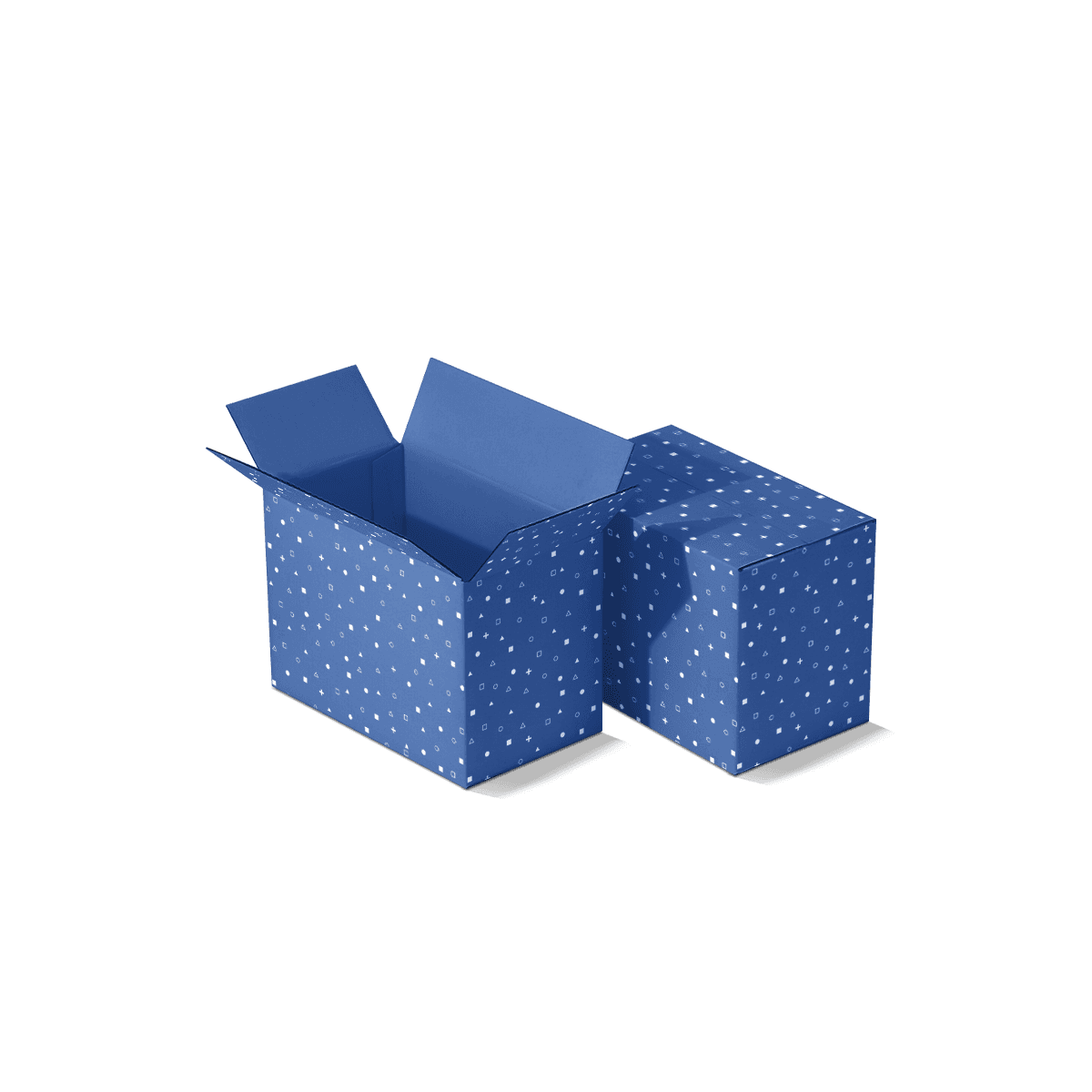
Custom Multi Depth Shipping Boxes use pre-scored horizontal depth lines so the same corrugated footprint can close at several planned heights. At the packing bench, the operator selects the appropriate score, cuts the corners down to that level, folds the upper panels and seals the case around the actual load.

Only the depth changes. The base length and width stay fixed. That distinction is what gives this structure its value. It can reduce the number of carton sizes a business holds without forcing shallow orders to travel inside a tall box.

The Scores Are Planned Positions, Not Unlimited Adjustment

A multi-depth box does not behave like a telescopic carton that can slide continuously to almost any height. Its useful closing positions are determined by the score lines built into the blank.

Those scores should correspond with real packing patterns. Three useful depths based on recurring order profiles can be more efficient than a long series of arbitrary lines that makes operators stop and decide which crease to use for every shipment.

Stable Length and Width Are the Entry Condition

This style works best when product footprints remain reasonably consistent while stack height, item count or accessory depth changes.

If the length and width vary just as much as the height, one adjustable-depth carton may still create large side voids. In that situation, a small family of different footprints can be more efficient than trying to force everything into one base size.
Score Positions Should Follow Real Orders

The strongest multi-depth specification starts with order data, not evenly spaced crease lines. Look at the packed heights that actually recur and group them into sensible depth bands.

If most orders close near 100 mm, 160 mm and 220 mm, scores near those working heights can create a clearer packing routine than generic increments that do not correspond with the products being shipped.

Depth Bands Need Packing Clearance

The score should sit above the finished contents with enough room for protective material and clean closure. It should not press the top panels into the product simply to remove every millimetre of air.

Measure the completed pack, including inserts, dividers, wrapping, accessories and any top pad that will remain inside the case. Controlled clearance is useful; unused vertical volume is not.

The sizing principle is similar to the one covered in choosing the right packaging box size: measure the complete packed arrangement rather than the bare product.

Do Not Add a Score for Every SKU

A score line should simplify stock or packing. If two product configurations finish only a small distance apart and both work comfortably at one depth, creating separate scores may add no operational value.

The aim is not maximum adjustability. It is the smallest number of useful closing heights that covers the recurring order mix cleanly.

One Carton Can Replace Several Heights

Stock rationalisation is where multi-depth shipping boxes can become commercially useful. One footprint with several planned depths can replace multiple fixed-height cartons when those cartons would otherwise differ mainly in height.

That can reduce the number of packaging SKUs staff have to locate, replenish and store.

Fewer Carton Codes Can Simplify Picking

A packing station holding six similar corrugated cases can create avoidable selection errors. If three of those cases share the same length and width and differ only in depth, a correctly specified multi-depth version may consolidate them.

The benefit is operational rather than cosmetic: fewer near-identical carton codes, fewer storage positions and a clearer choice at the bench.

Consolidation Has a Limit

Reducing carton SKUs is not automatically better. A universal footprint that is much too large for smaller products can save one stock location while increasing side void, filler and shipping volume on every order.

The useful question is therefore not “How many box sizes can we eliminate?” It is “Which fixed heights can one footprint replace without making the packed case worse?”

Regular Slotted Containers remain the cleaner option when a product or case quantity repeatedly finishes at one stable height.

The Wrong Score Still Creates Empty Space

Pre-scoring only reduces void when the selected depth is close to the actual packed height. A carton with 100 mm between score lines can still leave substantial headspace when the order sits midway between them.

This is why score spacing should follow real variation rather than a default production pattern.

A Three-Height Order Profile

Consider a fulfilment operation shipping boxed skincare sets on the same 340 × 250 mm footprint. Single sets finish around 85 mm high, two-set orders around 145 mm and promotional bundles around 205 mm once their protective pads are included.

Keeping separate 100 mm, 160 mm and 220 mm fixed-height cartons would work, but those cases occupy three stock positions and look similar at the bench. A multi-depth carton built around those three recurring pack heights could retain one footprint while giving each order group its own clear closing level.

The practical improvement is not merely less cardboard. Staff have one outer case to pick, three meaningful depth choices and less unused space above the products.

If the smallest order used only half the base footprint, however, the same solution would be weak. Height flexibility cannot correct a footprint that is wrong.

Void Fill Still Has a Protective Job

Reducing empty height does not mean eliminating protective material that serves a purpose. Fragile products may still need cushioning, separation or controlled clearance.

The fragile product packaging decision process is useful when empty space, cushioning and physical restraint are being confused. A lower score line should remove unnecessary volume, not remove protection the product genuinely needs.

Cutting Down Needs a Consistent Bench Method

Multi-depth cartons add one deliberate operation that a fixed-height RSC does not: the corners must be cut down to the chosen score before the upper panels are folded and sealed.

At low volume that step is simple. At higher volume, consistency matters because repeated cutting decisions become part of packing time and finished-case quality.

Score Lines Should Be Easy to Identify

Operators should not have to count faint creases or guess which level belongs to which order. The selected depths need a clear internal packing rule.

That can be as straightforward as assigning each standard order profile to a known carton depth. The goal is to remove decision-making, not shift it from carton selection to score-line selection.

Cut Only to the Intended Crease

Cutting beyond the selected fold line can weaken the corner area or produce untidy flaps. Stopping short can prevent the upper panel folding cleanly.

A physical sample is particularly useful for multi-depth packaging because it lets the packing team check how quickly the chosen levels can be identified, cut and closed with real contents. Free samples can support that confirmation before a larger recurring run.

Reduced Height Changes the Closed Case

Once a multi-depth carton is shortened, its final proportions change. The product sits closer to the top closure, the visible printed area changes and the case may stack differently from its maximum-height version.

Those states should be considered during design rather than treating the tallest configuration as the only finished box.

Artwork Must Work at Every Depth

A logo or instruction placed high on a side panel may be cut through or folded onto the top when the carton is used at a lower score.

Important branding, barcodes and handling information should stay within areas that remain visible at all intended depths, unless separate artwork behaviour is deliberately planned.

A free 3D mockup can help review the maximum-depth version, but the lower closing positions should also be checked on the dieline. Packaging dielines and artwork setup explains how creases, safe areas and panel placement affect printed structures.

Labels Need a Stable Zone

Courier labels and warehouse identifiers should have a predictable panel that remains usable whichever score is selected. Placing them in a cut-down zone creates avoidable variation at the packing bench.

For transit-first cases, functional print can matter more than using every available surface for branding.

Board Grade Must Cover the Tallest Load

Adjustable depth does not make the corrugated material adjustable. The board still has to perform across the heaviest and most demanding configuration expected from that carton.

If the box will sometimes carry one lightweight product and sometimes several dense units, specification should account for the higher loaded state.

Single or Double Wall Depends on Duty

Some multi-depth programmes can work in single wall corrugated. Heavier products, larger footprints or more demanding stacking may justify double wall.

Double Wall Shipping Boxes cover the two-flute material decision in more depth. Multi-depth describes the adjustable-height feature, not the wall construction.

For a broader flute and board assessment, Corrugated Shipping Boxes are the more relevant material reference.

The Shortest Setting Still Needs Internal Control

Lowering the top removes vertical void but does not control side-to-side movement. If products occupy only part of the base, inserts, pads or dividers may still be needed.

Inserts and Dividers can provide that internal control where the footprint remains constant but the products need separation or positioning.

Pallet Height Can Benefit From Cut-Down Cases

Reducing unused carton depth can improve more than the individual parcel. Where cases are palletised, lower finished heights can create a more compact and orderly load.

The benefit depends on how consistently the selected depths appear across the pallet.

Mixed Heights Need a Stacking Rule

A pallet containing several versions of the same adjustable carton can end up with uneven upper surfaces if different depth settings are mixed randomly.

For planned wholesale or warehouse movements, cases of similar finished height can be grouped or layered deliberately. Multi-depth flexibility should not create unstable pallet geometry.

The Base Footprint Never Changes

This can be an advantage because pallet length-and-width planning stays consistent even while the carton depth varies. It is also a limitation: if the footprint itself is inefficient on the pallet, adjusting height will not solve it.

The broader Shipping Boxes options are more useful when the underlying case footprint or structure also needs to change.

Adjustable Depth Is Not Custom Geometry

Multi-depth and die-cut shipping boxes solve different problems. Multi-depth keeps one basic footprint and gives it several planned heights. Die cutting can reshape panels, openings, locking features and product-specific geometry.

Die Cut Shipping Boxes make more sense when an awkward product needs custom structural features rather than simply a shorter case.

The distinction prevents over-engineering. If all the operation needs is three useful closing heights, custom locking geometry may add complexity without solving anything extra.

Depth Flexibility Should Reduce Total Complexity

The best multi-depth programme is not the carton with the most score lines. It is the one that removes more complexity from stockholding and packing than it adds at the bench.

MOQ starts from 100 boxes, so a business can establish one adjustable footprint around a real group of order heights before rationalising a larger carton set. Instant pricing is useful once the maximum dimensions, required depth positions, board specification and likely quantity are established.

For recurring operations, Bulk Custom Boxes can support an approved multi-depth specification with repeat production, warehousing and scheduled deliveries. Guaranteed 4–6 working day production and delivery can support replenishment once the depth plan is stable.

The useful end point is a depth matrix tied to real orders: which recurring pack profiles use the maximum height, which use each lower score and which products should stay in another carton altogether.

When that matrix genuinely reduces carton SKUs and empty height, request a custom packaging quote around the full multi-depth programme rather than treating adjustable height as an extra feature added to an arbitrary box.

FAQs

They are supplied with pre-scored depth lines around the case walls. The box is cut down to the required height at packing stage, then folded and sealed to suit the contents. This gives one carton more than one usable depth. The key is choosing score positions that match real packing needs rather than creating too many cut-down options that slow the process.

They are the stronger option when the footprint of the shipment stays similar but the pack height changes often. A standard corrugated case is still useful when every order has a consistent size and the packing line does not need adjustment. If your main problem is too many box heights in stock, multi depth construction can solve that more efficiently.

Start with the base length and width, then define the actual depth range the case needs to cover. It is also important to confirm packed weight at the tallest and shortest settings, how the cut-down will be made on the packing bench and whether inserts still fit correctly after height reduction. A test pack is worth doing before full production.

Yes, provided they are cut down cleanly and sealed correctly. In many cases they stack better than an oversized fixed-depth carton because the unused height has been removed. Performance still depends on board grade, packed weight and how evenly the load sits inside the case. If stacking strength is critical, that should be checked during the specification stage.

Yes. Multi depth construction can be produced in stronger corrugated grades where the product weight or transit conditions demand more support. That makes it possible to combine flexibility with better load performance. If the case must handle heavier contents and changing fill heights, review both the score layout and board strength together rather than treating them as separate decisions.

Process

How it works

Your Packaging Journey, From Idea to Production and Delivery

01

Tell Us Your Specs

Custom packaging boxes

Tell Us Your Specs

Provide size, quantity, printing, and finishes.

02

Get a Fast Quote

Custom packaging boxes

Get a Fast Quote

Instant transparent pricing, no hidden fees.

03

Design and Approval

Custom packaging boxes

Design and Approval

Artwork checks, revisions, and final sign-off.

04

Produce

Custom packaging boxes

Produce

Expert manufacturing to meet deadlines.

05

Ship to Your Door

Custom packaging boxes

Ship to Your Door

Hassle-free, flexible delivery options.

Get Your Quote for Custom Multi Depth Shipping Boxes

Share your product details, dimensions, quantity and artwork needs. We’ll help choose the right packaging style and send a clear quote.